
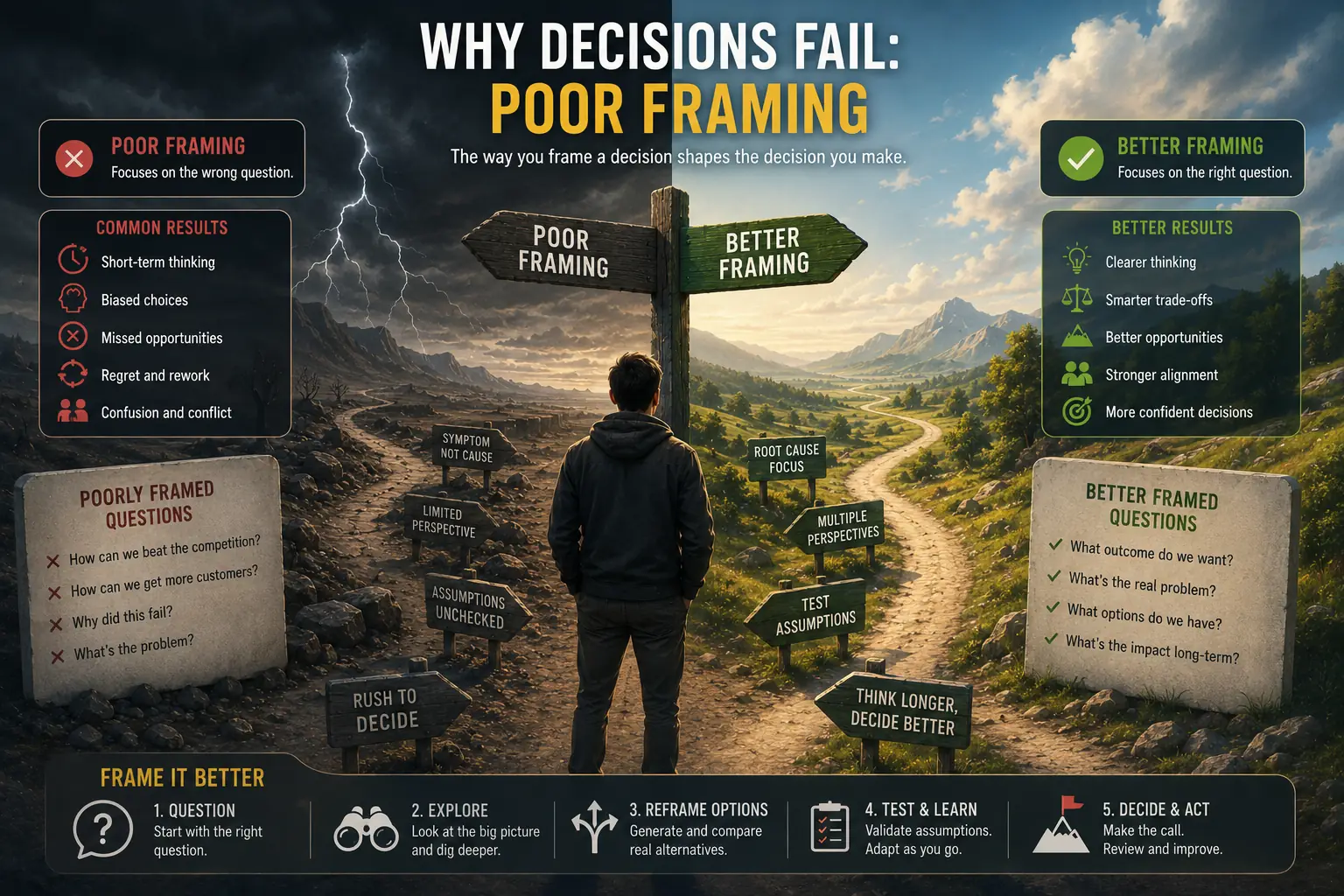
Why Most Decisions Fail Due to Poor Framing
This is the CitePep accuracy record for “Why Most Decisions Fail Due to Poor Framing”, published by When Notes Fly. It lists every change experts checked and accepted on that page.
Poor decision framing means asking the wrong question. 'Should I quit?' differs from 'What career maximizes growth?' Frame determines outcomes.
What has been corrected on this page?
Every accepted correction to this page is recorded with the exact change, so readers can see how the page improved over time.
-
Corrected one attribution: clarified that 'inattentional blindness' is a perceptual-psychology concept from Mack and Rock (1998), not a term Bazerman coined;
Bazerman and Chugh's own organizational term for the related phenomenon is 'bounded awareness.' Nutt's 376-decision study (Why Decisions Fail, 2002), the Marteau (1989) physician framing-effect replication, and the Kodak/George Fisher case study were verified accurate and left in place.
What the page claimedThe article stated that Bazerman called organizational bounded awareness 'inattentional blindness.'
What was correctedAttributed inattentional blindness to Mack and Rock (1998) and bounded awareness to Bazerman and Chugh, as two related but distinct concepts.
Why: Inattentional blindness is an established term from a different, earlier line of research; conflating it with Bazerman's own coinage misattributes it. Correction fixes the attribution rather than adding new sources.
View the full record →
Who checked this page?
1 contributor has checked "Why Most Decisions Fail Due to Poor Framing" on When Notes Fly. Each name below links to that person's public CitePep profile, where every contribution they have made is listed with the exact change they proposed.