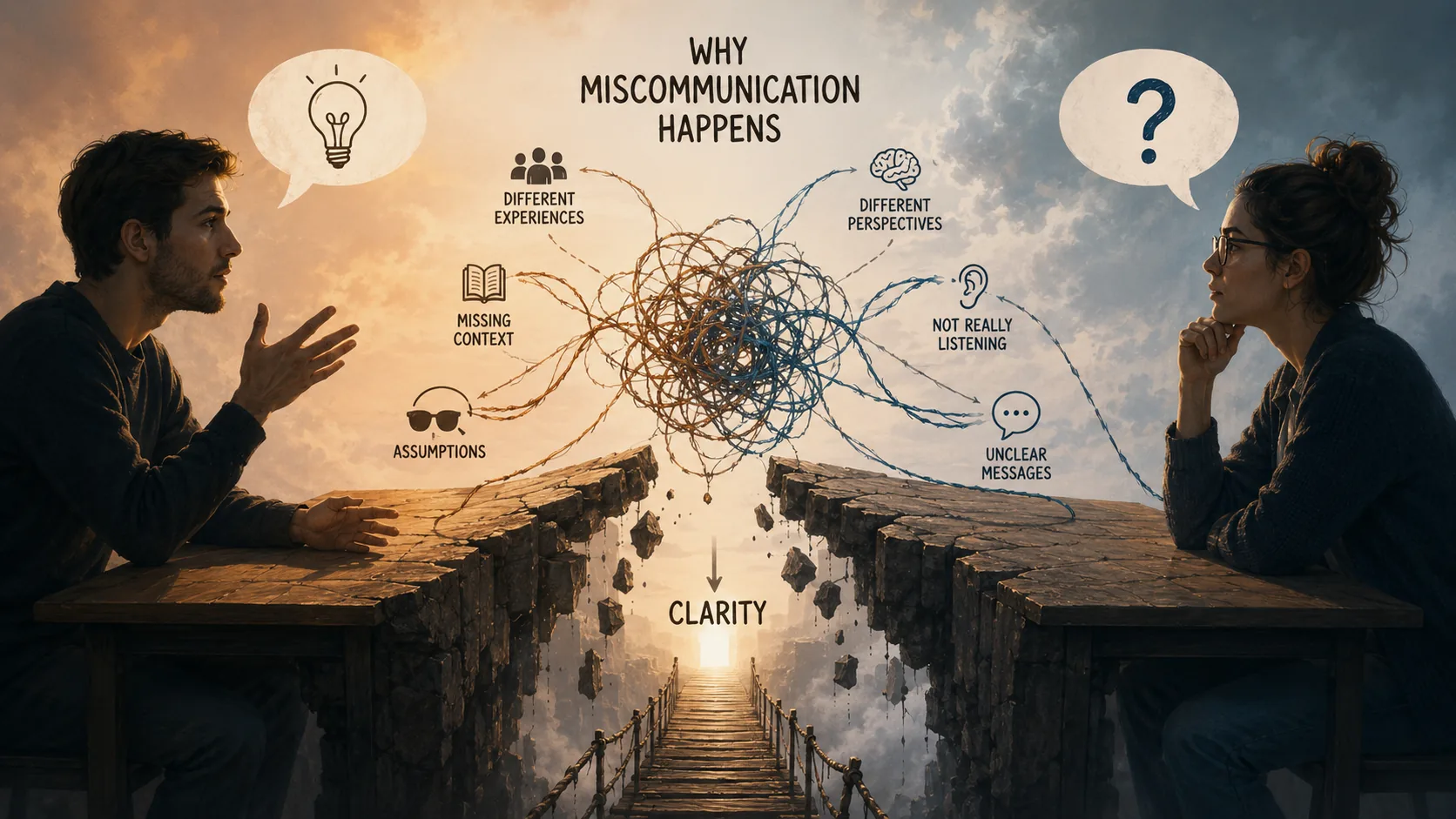
Why Miscommunication Happens
Clear wording is necessary but not sufficient. Six causes of miscommunication, and how to check understanding rather than acknowledgment.
What has been corrected on this page?
Every accepted correction to this page is recorded with the exact change, so readers can see how the page improved over time.
-
A second review, following an earlier correction to this page, found several study descriptions that did not match their sources, including one conceptual inversion.
The article described the illusion of transparency backwards: it said subjects tried to conceal an emotional reaction and then overestimated how successfully they had hidden it, believing they were more emotionally opaque than observers rated them. The finding is the reverse.
Gilovich, Savitsky and Medvec (1998) documented that people overestimate how visible their internal states are to others, so someone concealing a reaction typically believes observers can detect more than they actually can. The article also dated that research to 2003 and attributed it to Savitsky and Gilovich while bundling several separate experiments into one account.
It dated the email-tone research to a 2015 University of Chicago text-message study, when the relevant paper is Kruger, Epley, Parker and Ng (2005) on egocentrism over email, and separately attributed the same email findings to a 2003 Epley paper that does not exist in that form, distinct from Epley et al. 2004 on perspective taking.
It reported that Keysar and Henly found speakers believed they were understood 90 percent of the time against 61 to 67 percent actual comprehension, figures that could not be confirmed from the paper, and extended that study's scope to relationships and modalities it did not test.
It labelled sender overconfidence the Semmelweis problem, which refers to something else entirely, and cited a 2.4 million organizational cost figure with a derived 24-per-employee calculation, a most-common-cause ranking, and shareholder-return claims, none traceable to an inspectable methodology.
What the page claimedThe article stated: 'Kenneth Savitsky and Thomas Gilovich at Cornell conducted experiments in which subjects performed an emotionally evocative task... and then tried to conceal their emotional reaction... Subjects consistently overestimated how successfully they had hidden their emotional state - they believed they were significantly more emotionally opaque than observers rated them.' It described 'a 2015 study, researchers at the University of Chicago' on text-message tone with senders overestimating clarity 'by roughly 20 percentage points', and called the resulting gap 'the Semmelweis problem at everyday scale'. It separately attributed email-tone findings to 'Research by psychologist Nicholas Epley and colleagues on egocentrism and miscommunication (2003, Journal of Personality and Social Psychology)'. It reported that Keysar and Henly found speakers 'believed their messages were understood correctly 90% of the time when listeners understood the intended meaning only 67% of the time' and that 'The gap held across different types of messages, different speaker-listener relationships, and different communication modalities'. It said 'A study by David Grossman... found that organizations with 100,000 employees lose an average of 2 million per year', later '2.4 million - approximately 24 per employee per year', identified 'the most common source of costly miscommunication' as unstated assumptions about priorities, and claimed effective communicators 'delivered meaningfully higher total shareholder returns'. It said communication failures contributed to about 70% of sentinel events, 'a higher proportion than equipment failures, staffing inadequacies, or technical errors'. Of Tenerife it concluded 'The words were clear. The channel was functional. And the communication failed.' It presented 'The Meaning Reconstruction Model' and 'six mechanisms' as established research, with a summary table listing different mechanisms from the numbered sections.
What was correctedThe illusion of transparency now states the finding in its actual direction, that people overestimate how visible their internal states are to others, cited to Gilovich, Savitsky and Medvec 1998, with the note that someone concealing a reaction typically believes observers detect more than they do. The email-tone research is corrected to Kruger, Epley, Parker and Ng 2005 and separated from Epley, Keysar, Van Boven and Gilovich 2004, which is now described as the anchoring-and-insufficient-adjustment mechanism predicting larger errors under time pressure. The Keysar and Henly percentages were removed and the finding limited to the task tested. The Semmelweis label, the 2.4 million figure and its per-employee derivation, the most-common-cause ranking and the shareholder-return claim are all gone. The sentinel-event statistic is now framed as historical analysis of voluntarily reported events that does not represent all medical error, without the comparison against equipment and staffing failures, and SBAR is described as having moderate and variable evidence. The Tenerife opening is now a multi-factor chain, and the claim that the words were clear is replaced with an explicit statement that the phraseology was non-standard, one transmission was garbled by interference, and the parties held incompatible models of the runway, making it a case of ambiguous encoding and failed confirmation. The article's thesis is now stated as clear wording being necessary but not sufficient. The framework and the six-cause taxonomy are labelled WNF synthesis, the two incompatible mechanism lists were unified into one, Grice is described as a pragmatic theory rather than a demonstration, the curse of knowledge is qualified as bias rather than inability and shortened with a link to the dedicated article, and new material covers read-back versus teach-back versus closed-loop confirmation, limits on channel richness, cultural frameworks as tendencies, and the point that not every disagreement is a misunderstanding. Length went from about 4,070 to about 2,390 words.
Why: This page had already received one correction, but a claim-level re-review found that several of its study descriptions still did not match their sources.
The most serious was a reversal: the illusion of transparency was described as people overestimating how well they had concealed their feelings, when the documented finding is that people overestimate how visible their internal states are. Readers taking away the inverted version would draw the opposite practical conclusion.
Two further studies were misdated or attributed to papers that do not report what was claimed, exact percentages could not be confirmed against the cited paper, and a widely circulated organizational cost figure was presented with a derived per-employee calculation its methodology cannot support.
Corrections restore each finding to what its source establishes and label the article's own framework as editorial synthesis.
View the full record → -
Corrected two issues: separated the Grossman/Holmes Report $62.4 million communication-cost estimate from the 47% total-shareholder-return figure, which comes from a distinct line of corporate-communication research (in the Watson Wyatt/Willis Towers Watson tradition) rather than being part of Grossman's own study;
and qualified the SBAR protocol's reported reduction in communication-related adverse events as varying by study and hospital setting rather than a precise 37% figure from a specific 10-hospital, two-year implementation. The 2015 University of Chicago text-message study, the correct 1989 Camerer/Loewenstein/Weber curse-of-knowledge attribution, and the Epley et al.
2003 Journal of Personality and Social Psychology study were verified accurate and left in place.
What the page claimedThe article attributed both a $62.4 million cost estimate and a 47% shareholder-return figure to the same Grossman/Holmes Report study, and cited a precise 37% SBAR adverse-event reduction from a specific 10-hospital study.
What was correctedSeparated the two conflated studies and their sources, and reframed the SBAR figure as varying across studies rather than one precise result.
Why: Two distinct studies had been merged under one citation, and a precise improvement figure could not be tied to a single verifiable source. Corrections separate the attributions and scope the SBAR claim rather than adding new sources.
View the full record →
Who checked this page?
1 contributor has checked "Why Miscommunication Happens" on When Notes Fly. Each name below links to that person's public CitePep profile, where every contribution they have made is listed with the exact change they proposed.