
The Lindy Effect: Aging and Robustness Explained
This is the CitePep accuracy record for “The Lindy Effect: Aging and Robustness Explained”, published by When Notes Fly. It lists every change experts checked and accepted on that page.
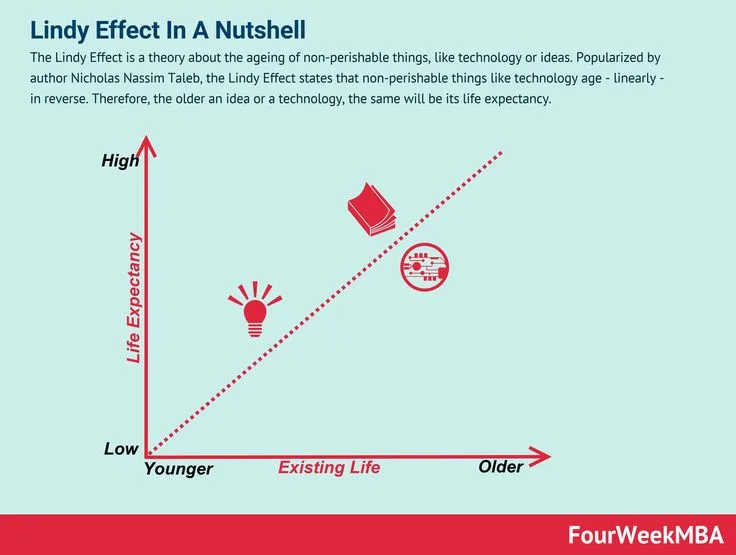
Learn about the Lindy Effect and how the longevity of certain things correlates with their future expectancy to thrive.
What is this page about?
An explainer of the Lindy Effect, the principle that for non-perishable things like books, ideas, and technologies, life expectancy increases with age because survival is evidence of robustness, named after the Broadway deli where comedians noticed long-running shows tended to keep running and formalized by Taleb in Antifragile.
It covers the statistical foundation (Pareto lifespan distribution), the filtering mechanism of time as selective pressure, applications (what to read, technology adoption, evaluating ideas and institutions), and the limits (non-stationarity, survivorship bias, domain-specific application).
What has been corrected on this page?
Every accepted correction to this page is recorded with the exact change, so readers can see how the page improved over time.
-
2 corrections applied: Gott made the Berlin Wall prediction in 1969 (forecasting 2.67-24 more years); the Wall fell in 1989, validating it. The original wording was internally incoherent. | The Lindy's Law concept came from Albert Goldman's 1964 article 'Lindy's Law' in The New Republic, not a 1966 New York Magazine piece titled 'The Comedy of Neil Simon.'
BeforeGott predicted, in 1993, that the Berlin Wall... / Goldman, A. (1966). The Comedy of Neil Simon. New York Magazine, 1966.
AfterGott predicted, in 1969, that the Berlin Wall... / Goldman, A. (1964). Lindy's Law. The New Republic, 1964. (Origin of the Lindy observation in show business.)
Why: Verified live: both corrections are already present, in the body text and the bibliography respectively. The FAQ does not reference Gott's Berlin Wall prediction or the Goldman citation at all, so no secondary fix was needed.
View the full record →
Who checked this page?
1 contributor has checked "The Lindy Effect: Aging and Robustness Explained" on When Notes Fly. Each name below links to that person's public CitePep profile, where every contribution they have made is listed with the exact change they proposed.