
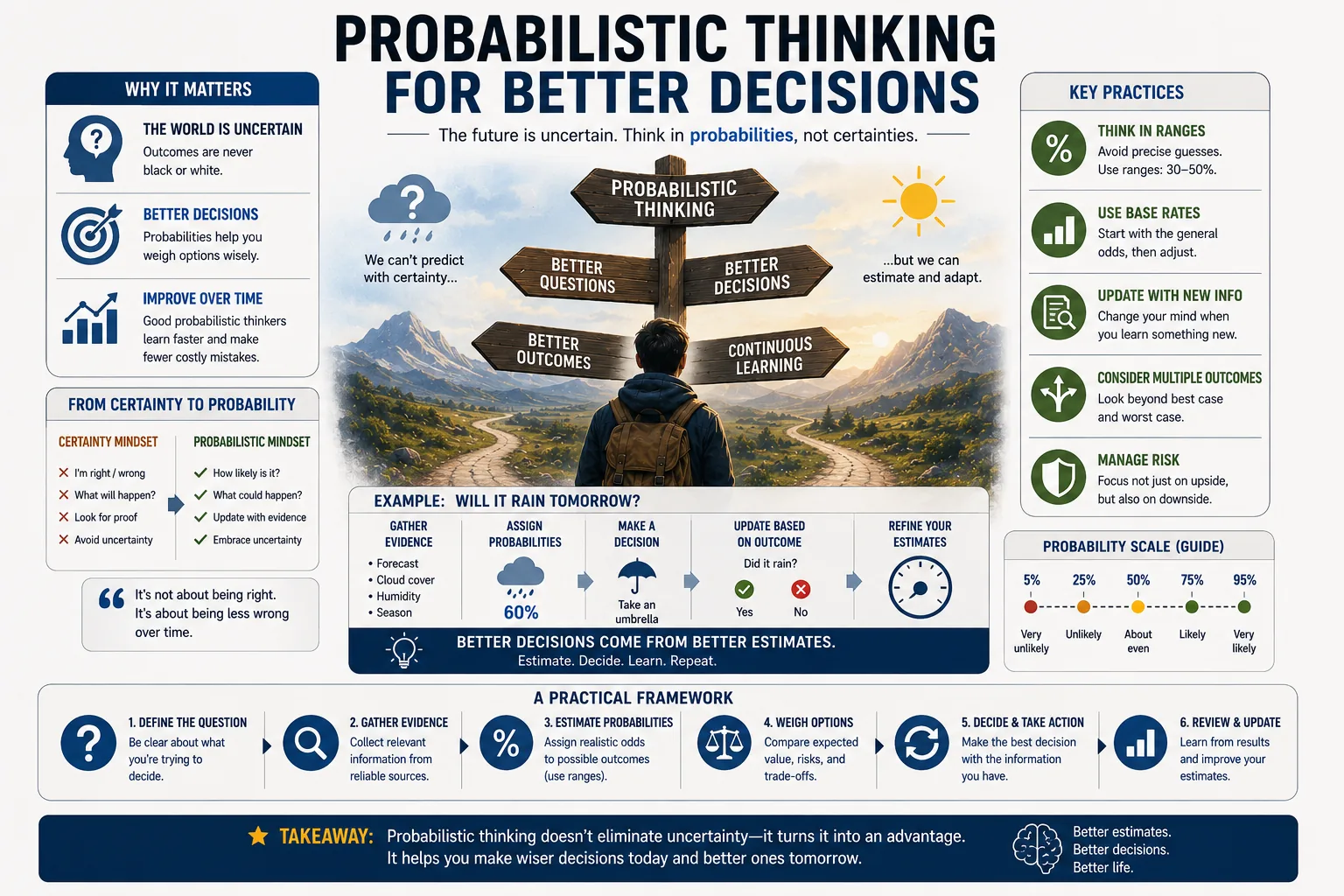
Probabilistic Thinking for Enhanced Decision-Making
This is the CitePep accuracy record for “Probabilistic Thinking for Enhanced Decision-Making”, published by When Notes Fly. It lists every change experts checked and accepted on that page.
Master the art of probabilistic thinking to evaluate outcomes more effectively and make informed decisions.
What has been corrected on this page?
Every accepted correction to this page is recorded with the exact change, so readers can see how the page improved over time.
-
Corrected two arithmetic/scale errors: fixed 'the top quartile of Good Judgment Project performers were selected as superforecasters' to 'roughly the top 2%,' since superforecaster designation was far more selective than a quartile (25%);
and corrected 'one project abandoned per ten initiated is a 90 percent attrition rate' to the arithmetically correct 'about a 10 percent attrition rate.' The Recode 2018 analysis of Amazon's ~30 discontinued product lines and the informal, explicitly-labeled 'not full math' Bayesian-updating illustration were accurate and left in place.
What the page claimedThe article said the Good Judgment Project's top quartile became superforecasters, and that Astro Teller's 'one in ten' Google X project-abandonment rate is a 90% attrition rate.
What was correctedCorrected the superforecaster selectivity to roughly the top 2% and fixed the attrition-rate arithmetic (1 in 10 is 10%, not 90%).
Why: One figure overstated how selective superforecaster status was, and the other was a basic arithmetic error (confusing 1-in-10 with 90%). Corrections fix the math rather than adding new sources.
View the full record →
Who checked this page?
1 contributor has checked "Probabilistic Thinking for Enhanced Decision-Making" on When Notes Fly. Each name below links to that person's public CitePep profile, where every contribution they have made is listed with the exact change they proposed.