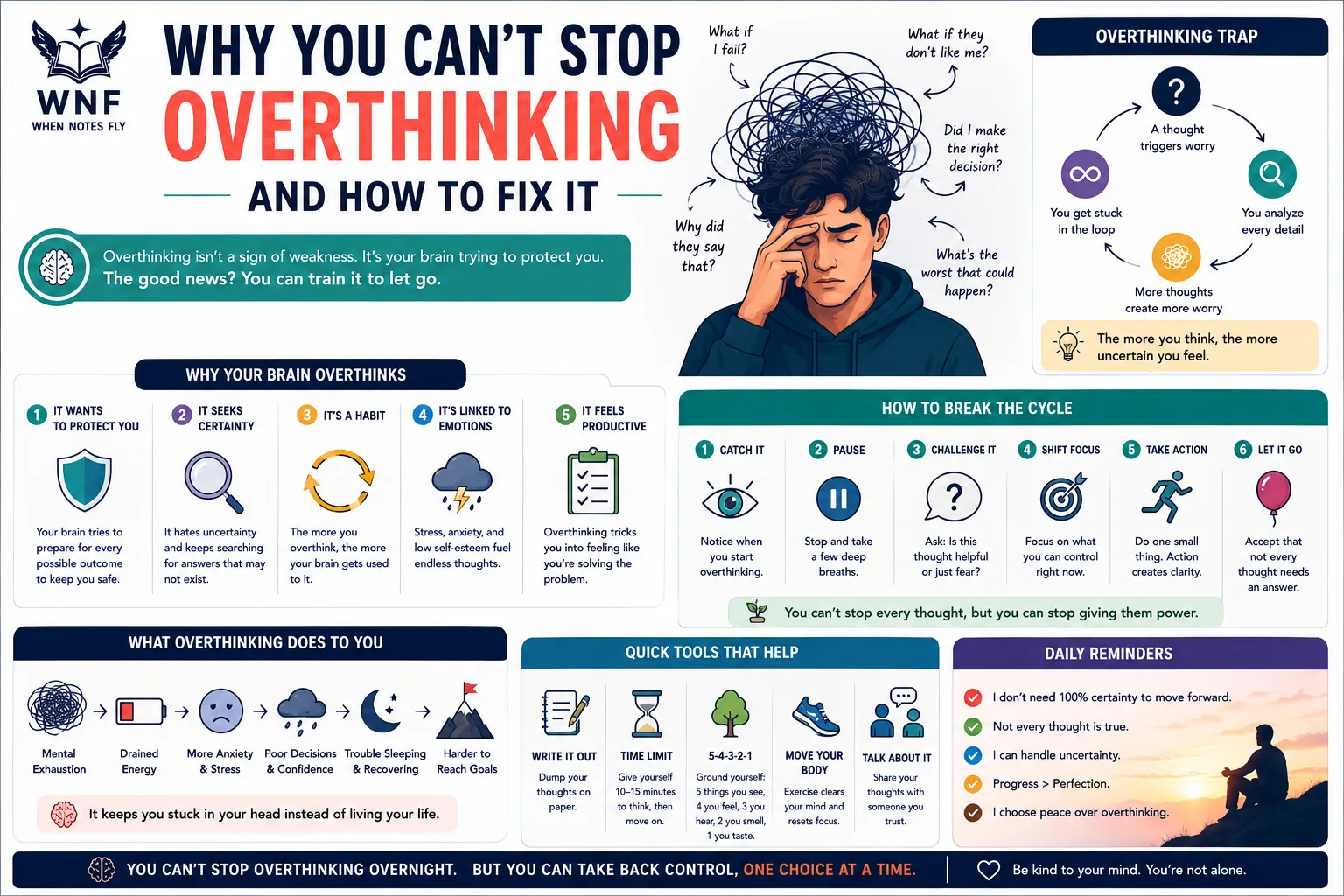
Overthinking and Rumination: Why Thought Loops Persist and What Can Help
This is the CitePep accuracy record for “Overthinking and Rumination: Why Thought Loops Persist and What Can Help”, published by When Notes Fly. It lists every change experts checked and accepted on that page.
What rumination research supports about overthinking: how repetitive thought differs from problem-solving, which strategies have evidence, and limits.
What has been corrected on this page?
Every accepted correction to this page is recorded with the exact change, so readers can see how the page improved over time.
-
The article contained a fabricated quote attributed to Susan Nolen-Hoeksema, several invented numeric thresholds (a 20-minute rumination rule, a 15-minute resolution estimate, a 20-minute pre-screen rule,
and a claim about morning default-mode-network activity), an unsupported diagnostic distinction between anxiety and ADHD based on thought patterns, an unsupported claim that stimulants reduce overthinking, and no immediate-crisis-safety instruction near its mention of suicidal ideation.
What the page claimedNolen-Hoeksema described rumination in a quoted passage attributed directly to her, and the article stated specific numeric rules including a 20-minute rumination limit, a 15-minute resolution estimate, a 20-minute pre-screen rule, and a claim that default-mode-network activity is elevated in the morning. It also drew a diagnostic line between anxiety and ADHD based on thought pattern shape, claimed stimulants reduce overthinking, and made no mention of what to do in a safety emergency near its discussion of suicidal ideation.
What was correctedThe quote was replaced with an attributed paraphrase of Nolen-Hoeksema research findings. All invented numeric thresholds were removed or replaced with qualified ranges drawn from the cited sources. The anxiety-versus-ADHD section was rewritten to state plainly that thought-pattern shape is not an accepted diagnostic distinction. A crisis-safety instruction directing readers at immediate risk of self-harm to contact local emergency or crisis services was added. The FAQ was corrected to remove overstated claims about mechanisms and treatment matching, and the article was moved to the Psychology and Behavior category and trimmed to roughly 2,200 to 2,800 words.
Why: Fact-check review found a fabricated quote, several invented numeric thresholds not supported by the cited sources, an unsupported clinical distinction, an unsupported treatment claim, and a missing safety instruction next to a mention of suicidal ideation.
View the full record → -
A review of this article on overthinking found a likely-fabricated quotation attributed to Susan Nolen-Hoeksema's Women Who Think Too Much, along with an arbitrary twenty-minute rumination threshold presented as her finding.
It also found the neuroscience sections stated group-level imaging associations as individual causal mechanisms, described rumination as a single inhibitory-system deficit, attributed a specific brain circuit to Sonia Bishop without any corresponding reference, and asserted that brain scans can show rumination directly.
Further issues included an anxiety-versus-ADHD comparison presented as a diagnostic distinction, an unsourced claim that stimulant treatment reduces overthinking,
invented specifics about morning default-mode activity, paper-versus-digital journaling, and fiction reading shutting down the default mode network, worry-postponement evidence presented more confidently than the literature supports, and a daily routine presented as research-validated. The article discussed suicidal ideation without any immediate crisis instruction.
What the page claimedThe article presented a block quotation attributed to Susan Nolen-Hoeksema's Women Who Think Too Much ('Problem-solving moves. Rumination circles...') that could not be verified as genuine wording, including a rule that considering a question for more than twenty minutes means you are practicing the problem rather than solving it. It described overthinking as 'often unconscious' and as consuming cognitive resources 'at a rate the brain is not equipped to sustain'. It stated that rumination is observable in imaging as a failure of the default mode network to quiet, that in ruminators 'this inhibitory function is impaired', and that interventions work by targeting that inhibitory system. It attributed a specific prefrontal-subcortical circuit to Sonia Bishop, whose work appeared nowhere in the bibliography. It presented an anxiety-versus-ADHD comparison as a clinical distinction and claimed stimulant treatment often reduces overthinking as a side effect of improved executive function. It asserted that the default mode network is most active in the morning, that paper journaling works better than digital, that reading fiction supports shutdown of the default mode network, and that a specific question might resolve in fifteen minutes. Worry postponement was described as consistently improving worry, emotional intensity, and sleep, with its mechanism stated as fact. A morning-to-sleep daily routine was introduced as combining 'what the research supports'. The page discussed suicidal ideation but gave no immediate crisis instruction, stated that 'evaluation costs little', and addressed guidance 'For clinicians' despite editorial-only attribution.
What was correctedThe disputed quotation and the twenty-minute rule were removed and replaced with an attributed paraphrase of Nolen-Hoeksema's actual distinction between rumination and productive problem-solving. Overthinking is now introduced as an informal umbrella term covering rumination, worry, obsessive doubt, and post-event processing, and described as automatic and hard to disengage from rather than unconscious. The neuroscience section now states group-level associations without causal framing, notes explicitly that a scan cannot identify rumination in an individual and that the default mode network is not the brain's overthinking circuit, and replaces the single-inhibitory-deficit account with the multiple contributing factors the literature describes. The Sonia Bishop attribution was deleted. The anxiety-versus-ADHD comparison was replaced with an explicit statement that repetitive thinking is not an ADHD diagnostic criterion and that thought content and pattern cannot reliably distinguish the conditions; the stimulant claim was deleted. Invented specifics on morning DMN activity, paper-versus-digital journaling, fiction and the DMN, and the fifteen-minute estimate were removed. Worry postponement, MCT, MBCT, defusion, behavioral activation, and affect labeling were requalified to match their sources, and the 5-5-5 and 5-4-3-2-1 exercises are now labeled popular techniques rather than validated treatments. The daily routine is labeled a WhenNotesFly synthesis that has not been evaluated as a clinical protocol. A crisis-services instruction and an educational-not-medical-advice disclosure were added, the clinician-directed section became 'For therapeutic discussions', a Wegner thought-suppression reference was added, and the page was retitled 'Overthinking and Rumination: Why Thought Loops Persist and What Can Help'.
Why: A claim-level review found one likely fabricated quotation, several neuroscience overstatements that converted group-level imaging associations into individual causal mechanisms, an unsupported anxiety-versus-ADHD diagnostic comparison, an unsourced ADHD medication claim, and multiple invented specifics presented as research findings.
Because the article covers depression, anxiety, ADHD, medication, and suicidal ideation, the overstated certainty and the absence of crisis guidance were treated as a reader-safety problem as well as an accuracy one. Corrections reduce each claim to what its cited source actually supports, label editorial synthesis as such, and add appropriate safety and scope disclosures.
View the full record →
Who checked this page?
1 contributor has checked "Overthinking and Rumination: Why Thought Loops Persist and What Can Help" on When Notes Fly. Each name below links to that person's public CitePep profile, where every contribution they have made is listed with the exact change they proposed.