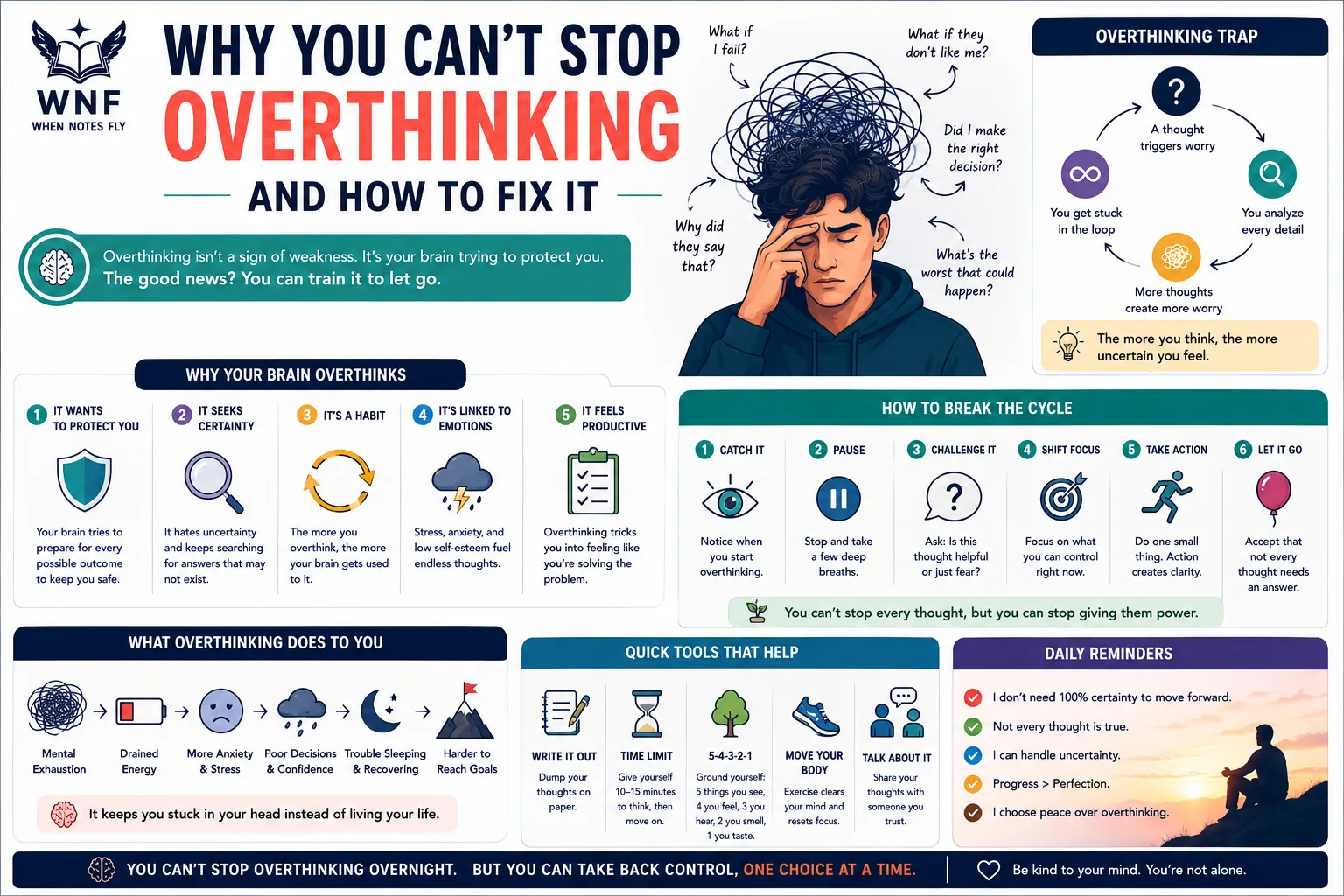
Overthinking and Rumination: Why Thought Loops Persist and What Can Help
What rumination research supports about overthinking: how repetitive thought differs from problem-solving, which strategies have evidence, and limits.
What was corrected
Nolen-Hoeksema described rumination in a quoted passage attributed directly to her, and the article stated specific numeric rules including a 20-minute rumination limit, a 15-minute resolution estimate, a 20-minute pre-screen rule, and a claim that default-mode-network activity is elevated in the morning. It also drew a diagnostic line between anxiety and ADHD based on thought pattern shape, claimed stimulants reduce overthinking, and made no mention of what to do in a safety emergency near its discussion of suicidal ideation.
The quote was replaced with an attributed paraphrase of Nolen-Hoeksema research findings. All invented numeric thresholds were removed or replaced with qualified ranges drawn from the cited sources. The anxiety-versus-ADHD section was rewritten to state plainly that thought-pattern shape is not an accepted diagnostic distinction. A crisis-safety instruction directing readers at immediate risk of self-harm to contact local emergency or crisis services was added. The FAQ was corrected to remove overstated claims about mechanisms and treatment matching, and the article was moved to the Psychology and Behavior category and trimmed to roughly 2,200 to 2,800 words.
Suggested change
The fabricated quote was replaced with an attributed paraphrase, all invented numeric thresholds were removed or softened to ranges and qualifiers, the ADHD section was rewritten to remove the false diagnostic distinction, crisis-safety language was added, the FAQ was corrected to remove overstated claims, the article was moved to the more appropriate Psychology and Behavior category, and the length was trimmed to approximately 2,200 to 2,800 words.
Why this is better
Fact-check review found a fabricated quote, several invented numeric thresholds not supported by the cited sources, an unsupported clinical distinction, an unsupported treatment claim, and a missing safety instruction next to a mention of suicidal ideation.