
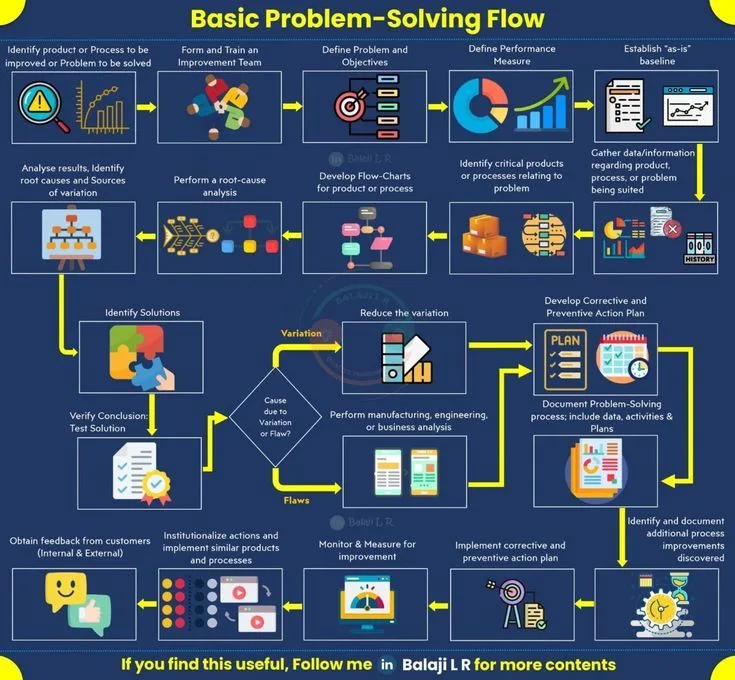
Correction Problem Solving Frameworks
Problem-Solving Framework Template
Define problem clearly. Identify root causes. List constraints like time and resources. Generate solutions. Test and iterate.
Needs stronger evidenceFactually incorrect
The exact change
Before
Two sections ('What Research Shows' and 'Real-World Case Studies') attached unverified precise statistics to real sources: an unverified 85%/25% figure for Spradlin's 2012 HBR article; an unverified '62 business teams, 73% vs 28%' checklist study for Wedell-Wedellsborg (his real 85%/87% executive-survey figures were accurate and kept); an entirely unverified experimental study with 45%/38%/64%/19% figures attributed to Tina Seelig's inGenius, which is a trade book with no such study; an unverified '2.8 times longer' statistic attributed to Dietrich Dorner's The Logic of Failure; an unverified 35%/14% Toyota defect-rate study misattributed to John Shook's real 2009 Sloan Management Review article; an entirely unverified 'GM Quality Council 2012 annual review' with a 22% figure with no real source; an unverified 2009 GAO report on Army Corps dam safety with 67%/31%/89%/52% figures (real GAO post-Katrina work covered levees, not this study); and unverified IDEO/Stanford d.school statistics (84%/43% success rates, '27,000 students') plus a factual error stating the d.school was founded in 2004 (it was actually founded in 2005).
After
Both sections rewritten to describe only the real, verifiable substance of each source (Spradlin's and Wedell-Wedellsborg's actual arguments about problem framing, with Wedell-Wedellsborg's real survey figures kept; Dorner's simulation methodology and central finding; Shook's real A3 report description; IDEO's Design Thinking framework and Tim Brown's real book) with all unverified statistics, the unverified Seelig study, the unverified GM and GAO case studies, and the d.school founding-year error removed or corrected.
Why this is better
Independent verification found 7 of 8 major statistical claims in this article were either entirely unverified (Seelig study, GM Quality Council, GAO dam-safety report) or real citations with unverified numbers attached (Spradlin, Wedell-Wedellsborg's checklist test, Dorner, Shook, IDEO), plus one standalone factual error (d.school founding year). Only Wedell-Wedellsborg's core 85%/87% survey statistics were verified accurate and preserved.