
Correction Psychology Behavior
The Mere Exposure Effect: Why Familiarity Breeds Liking
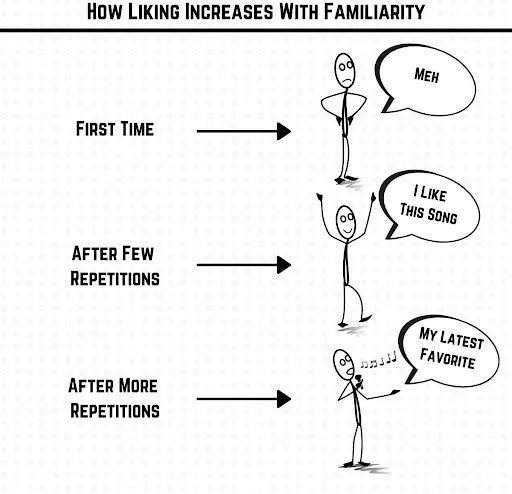
The mere exposure effect: repetition raises liking even for images people cannot consciously recall seeing, and works best unnoticed.
Needs stronger evidence
The exact change
Before
Research by Kunst-Wilson and Zajonc (1980) and later work by Letizia Caso and colleagues found that individuals high in need for cognition - the trait-level tendency to engage in effortful thinking - show somewhat attenuated Mere Exposure Effects in supraliminal conditions, possibly because they engage in more deliberate evaluation of stimuli that counteracts the fluency-based affect. Individuals low in need for cognition show stronger effects. This moderation is consistent with the dual-process interpretation: the Mere Exposure Effect is primarily a System 1 (automatic, affective) phenomenon, and individuals who heavily engage System 2 (deliberate, analytical) processing attenuate it.
After
(removed) (removed)
Why this is better
No study by Caso on need for cognition and mere exposure found in searches. Source: web search Describes the same unfound need-for-cognition finding. Source: web search
More by Emir Baycan in Psychology Behavior
- Correction Understanding Positive Psychology's Key Concepts
- Correction The Impact of Sleep on Learning and Memory
- Correction Retroactive Interference and Memory Disruption Defined
- Correction Dunning-Kruger Effect: Key Research and Myths