
Correction Psychology Behavior
Groupthink: How Cohesion Leads to Poor Decision-Making
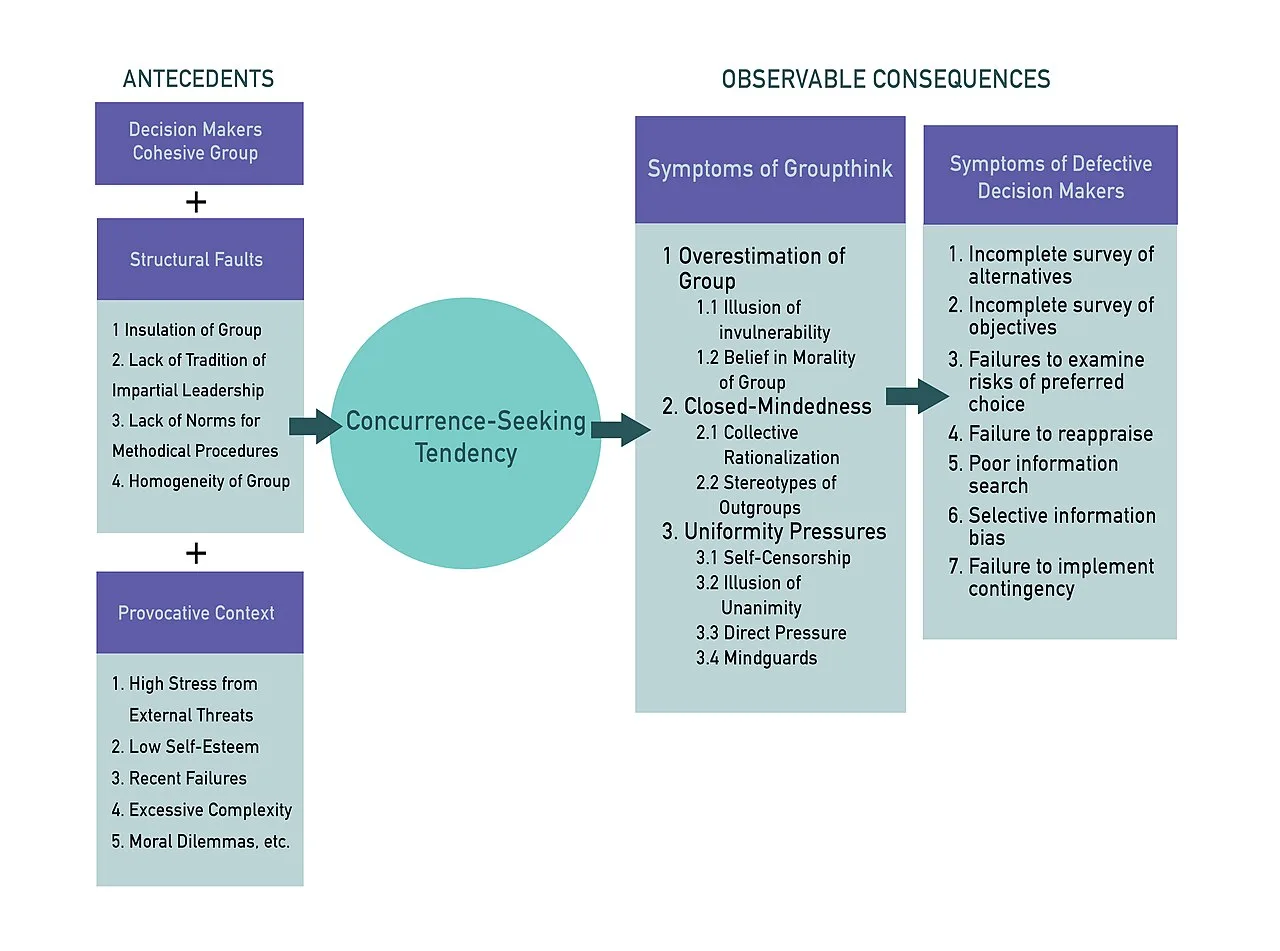
What is groupthink: Janis named eight symptoms from the Bay of Pigs, but critics showed he picked only cases already known to have failed.
Factually incorrect
The exact change
Before
Research by Peterson, Owens, Tetlock, Fan and Martorana (1998) found that directive leadership reliably suppressed information sharing in group decisions even when cohesion was low - suggesting that directive leadership may be the more potent antecedent condition, with cohesion playing a secondary role.
After
Research by Peterson, Owens, Tetlock, Fan and Martorana (1998) on the top management teams of seven Fortune 500 companies found that groupthink and vigilance profiles were substantially correlated with failing and successful groups respectively, though the fit was imperfect: successful groups showed some indicators of groupthink, such as cohesion and strong, opinionated leaders.
Why this is better
The paper's abstract reports a Q-sort study of seven Fortune 500 top management teams with an imperfect groupthink/vigilance fit; it does not report the directive-leadership claim. Source: https://doi.org/10.1006/obhd.1998.2763
More by Emir Baycan in Psychology Behavior
- Correction Understanding Positive Psychology's Key Concepts
- Correction The Impact of Sleep on Learning and Memory
- Correction Retroactive Interference and Memory Disruption Defined
- Correction Dunning-Kruger Effect: Key Research and Myths