
Correction Psychology Behavior
The Decoy Effect: How Choices Influence Your Decisions
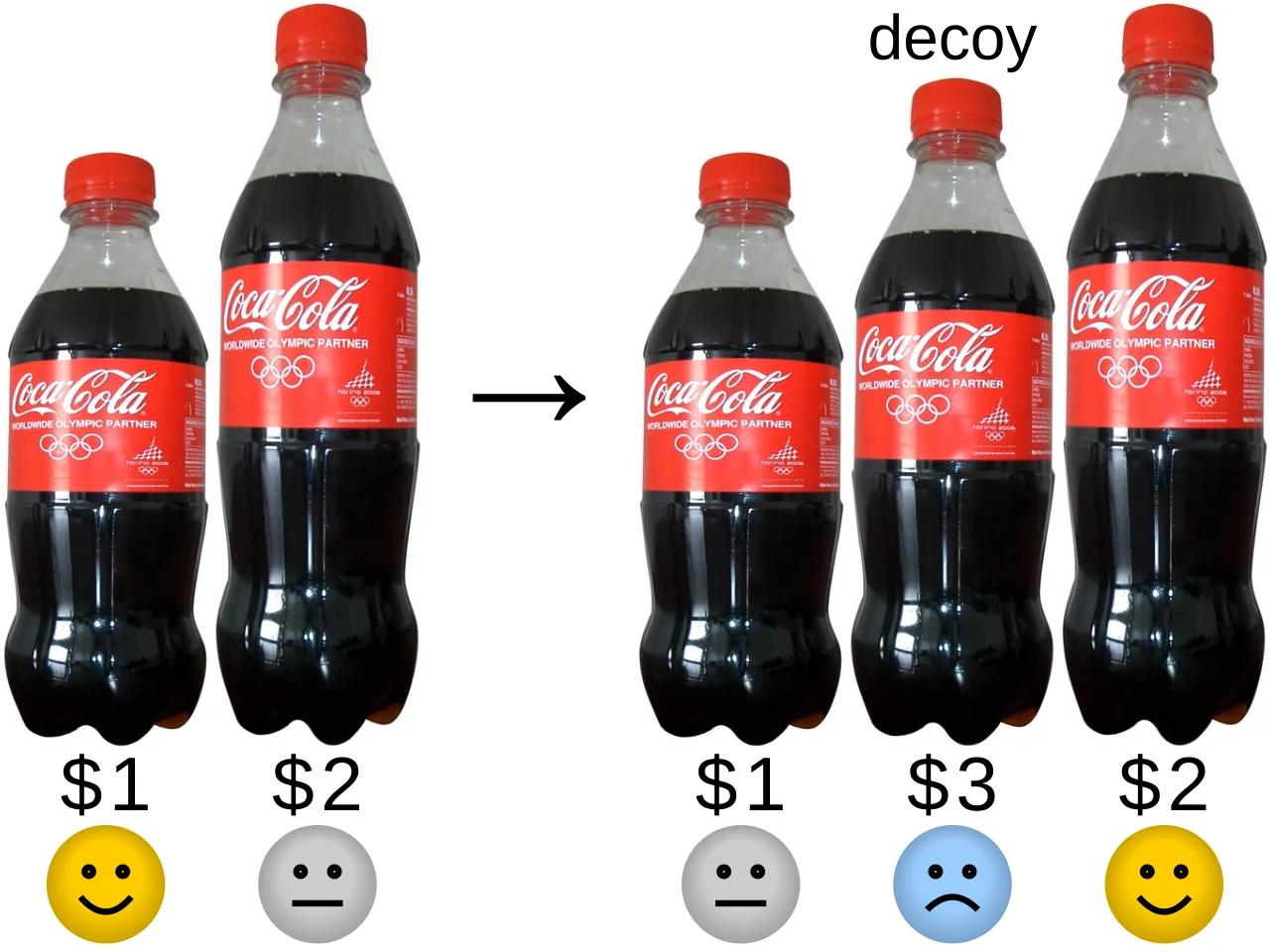
The decoy effect: adding a worse option raises demand for a better one, breaking the regularity axiom of rational choice.
Factually incorrect
The exact change
Before
A 2010 study by Hedgcock and Rao, published in the Journal of Marketing Research, used eye-tracking to show that participants spent more time looking at the target option and the decoy than at the competitor, suggesting that the decoy captures attention and directs it toward the comparison that flatters the target. | A 2004 paper by Simon and Colleagues, drawing on the reason-based choice framework, demonstrated experimentally that
After
A 2009 study by Hedgcock and Rao, published in the Journal of Marketing Research, used functional MRI to show that adding a decoy reduced activity in brain regions associated with negative emotion, suggesting that the decoy relieves the discomfort of a difficult trade-off. | A 1995 paper by Yigang Pan, Sue O'Curry, and Robert Pitts in the Journal of Consumer Psychology applied the attraction effect to political choice, arguing that
Suggested change
Corrected 2 figures to the published source.
Why this is better
Each study and survey figure in the article was checked against the published source. Figures that differed from the source were corrected to the source's own numbers, dates and attribution.
More by Emir Baycan in Psychology Behavior
- Correction Chronic Procrastination in Highly Motivated People
- Correction The Evolutionary Purpose of Emotions Explained
- Correction Why Mental Health Rates Are Changing
- Correction Insights on Great Leadership from 50 Years of Research