
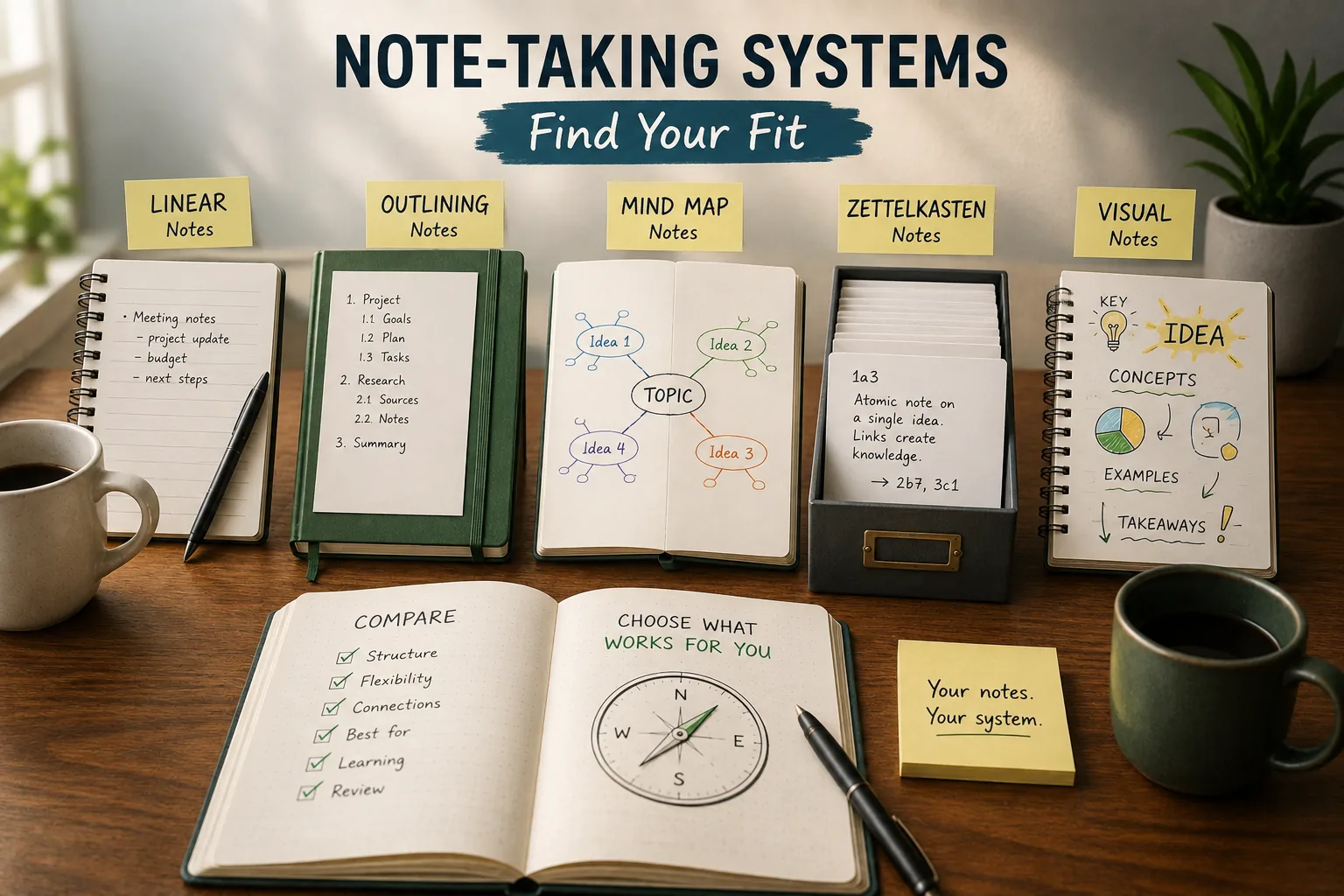
Correction Note Taking Systems
Comparative Overview of Note-Taking Systems
A comparative overview of note-taking systems: Zettelkasten, PARA, Cornell, chronological, and folders, and which fits your workflow.
Needs stronger evidenceFactually incorrect
What was corrected
What the page claimed
Article claimed a 2019 Morehead/Dunlosky/Rawson replication found handwriting's advantage disappeared specifically when subjects were instructed to paraphrase rather than transcribe - a mechanism not clearly supported by the real study. It also cited a real Google paper (Murphy-Hill et al., IEEE TSE) as the source of an unverified statistic ('40% lower time to first useful change' for co-located documentation) that could not be verified in that paper, which is actually about self-rated productivity correlates like peer support and feedback. It further attributed an unverified '40% of information value lost within 12 months' statistic to published Notion enterprise data with no real source. Finally, the live page ended with a leaked content-generation status line ('Article #74 of minimum 79 | Work-Skills: Professional-Tools (15/20 empty sub-topics completed)') that is internal production metadata, not reader-facing content.
What was corrected
Morehead et al. reworded to describe only the verified finding (conceptual-question advantage did not reliably replicate) without the unverified paraphrase-instruction mechanism. Google/Murphy-Hill statistic replaced with an accurate description of that paper's actual findings. Notion statistic removed, keeping only the underlying (unattributed, general) point about maintenance workflows. Leaked metadata footer deleted.
Why this is better
Independent verification found the Mueller & Oppenheimer 2014 study and Luhmann's Zettelkasten output figures were accurately reported, but two further claims paired real, checkable sources (a real Google paper, a real company) with statistics that do not exist in any locatable source - the same fabrication pattern found throughout this fact-check project. The metadata footer was an unrelated production artifact caught during the same content review.