
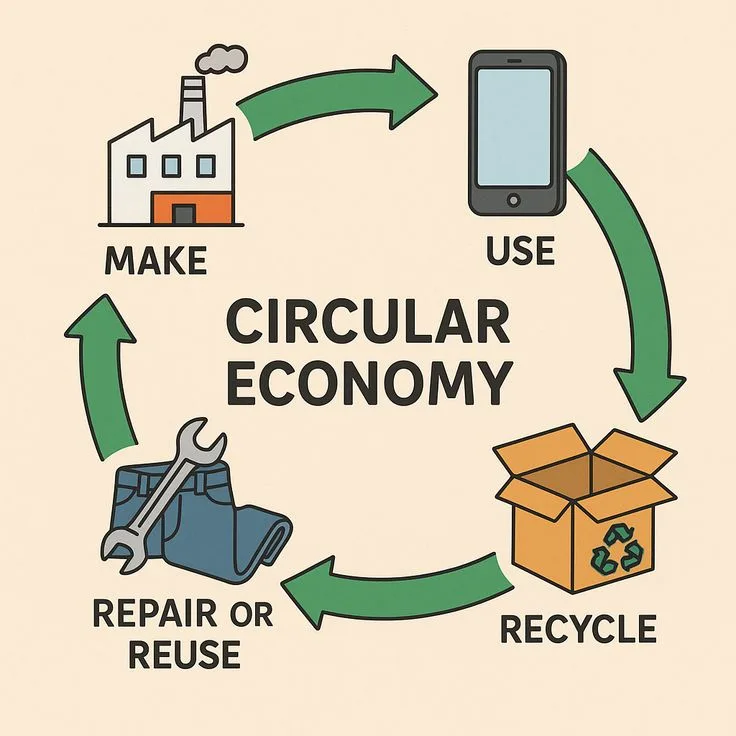
What Is the Circular Economy and How It Works
What is circular economy, recycling is the lowest-value loop, and only about 9% of plastic ever produced has been recycled.
The exact change
Renault's remanufacturing operation at Choisy-le-Roi in France processes tens of thousands of starter motors, gearboxes, and other components per year, selling them under its "Reman" brand at roughly 30-50% below new part prices. Caterpillar remanufactures more than 3 million units annually through its Cat Reman program. Platforms that enable sharing, of cars, tools, workspace, clothing, reduce the total number of units needed to deliver equivalent utility. The sharing economy is not automatically circular, but when designed to reduce ownership-driven overcapacity, it can significantly reduce material throughput. Beyond cost savings, circular economy advocates argue that the transition creates net employment. Repair, remanufacturing, and reuse are inherently more labor-intensive than virgin production: you cannot automate refurbishing a carpet tile the way you can automate spinning a new one.
Sharing and Access Models If private car ownership in dense urban areas were substantially replaced by car-sharing, the total stock of vehicles, and the materials required to produce them, would fall dramatically, even with no change in vehicle technology. The net employment effect depends heavily on transition speed and the availability of retraining. But the directional argument, that more labor-intensive circular activities are more employment-generating than capital-intensive linear ones, is consistent with economic logic.
Why this is better
RIC cites about $160 billion worldwide; $53.8 billion (2020) is a market-research figure for automotive parts remanufacturing only. Source: https://www.newswire.com/news/second-annual-reman-day-is-a-resounding-2839133-20871442 The nine to thirteen figure comes from carsharing research (UC Davis study, cited by RAND and WRI), not a 2016 RMI analysis. Source: https://www.escholarship.org/uc/item/0850h6r5.pdf ILO World Employment and Social Outlook 2018: the 24 million figure is for a green economy (energy sustainability) scenario, not circular economy practices specifically. Source: https://www.ilo.org/resource/news/24-million-jobs-open-green-economy-0
More by Emir Baycan in Systems Complexity
- Correction Unintended Consequences Explained: The Cobra Effect and Merton's Typology
- Correction Collective Intelligence: Group Decision-Making Benefits
- Correction Network Science: Understanding Connections and Patterns
- Correction What Is the Circular Economy and How It Works