
Correction Psychology Behavior
Baader-Meinhof Phenomenon: The Frequency Illusion Explained
Baader-Meinhof phenomenon, the name came from a 1994 newspaper comment thread, and Google Trends can test whether it is really happening.
Factually incorrect
The exact change
Before
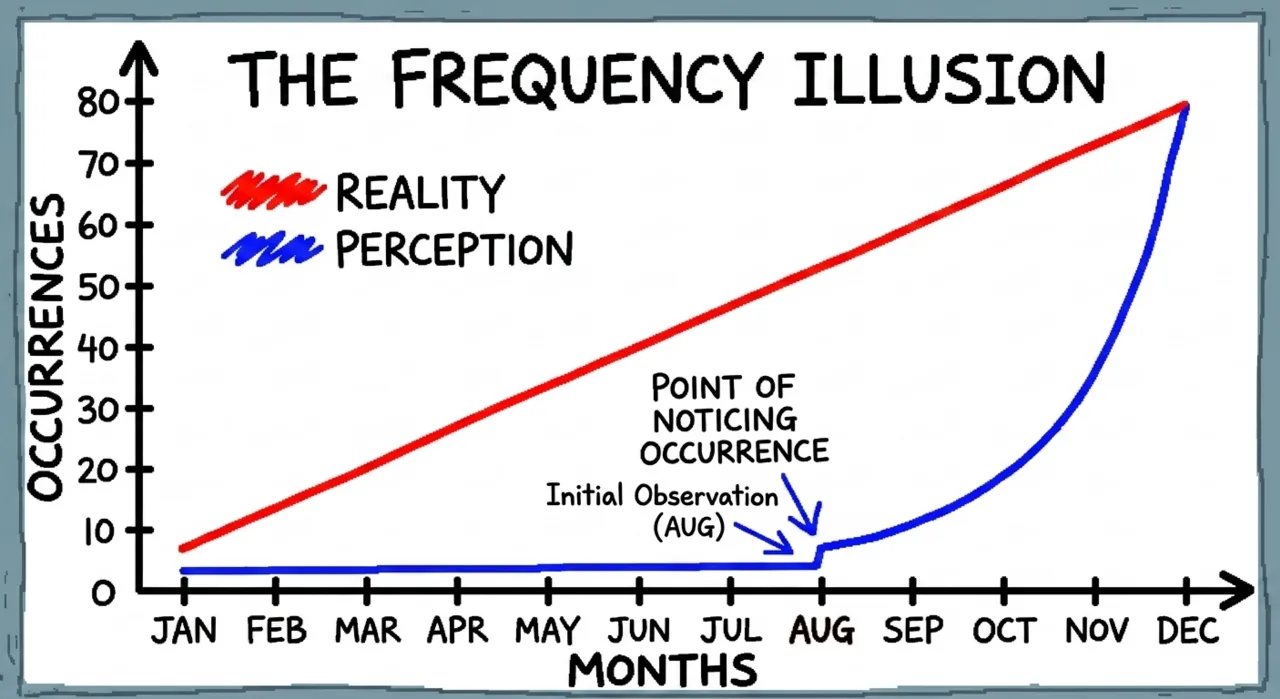
This creates the impression that the brand is ubiquitous, even if its actual market penetration is modest. The psychological effect of frequency is disproportionate to the actual frequency. The mere exposure effect: The tendency to develop preference for things simply because they have become familiar. Repeated noticing through the frequency illusion can trigger the mere exposure effect, generating mild positive associations with something encountered frequently.
After
Brand Awareness Campaigns The Baader-Meinhof mechanism, by increasing encountered frequency of recently learned items, inadvertently generates mere exposure effects that may make those items more positively evaluated.
Why this is better
The retargeting timing study is Sahni, Narayanan and Kalyanam (JMR 2019): ads in the first week after a visit were more effective; no 2014 Bart et al. timing study found. Source: https://doi.org/10.1177/0022243718813987 Zajonc 1968 showed mere exposure raises liking; the subliminal result is Kunst-Wilson and Zajonc 1980, so the clause was removed from the 1968 claim. Source: https://doi.org/10.1126/science.7352271
More by Emir Baycan in Psychology Behavior
- Correction Understanding Positive Psychology's Key Concepts
- Correction The Impact of Sleep on Learning and Memory
- Correction Retroactive Interference and Memory Disruption Defined
- Correction Dunning-Kruger Effect: Key Research and Myths