
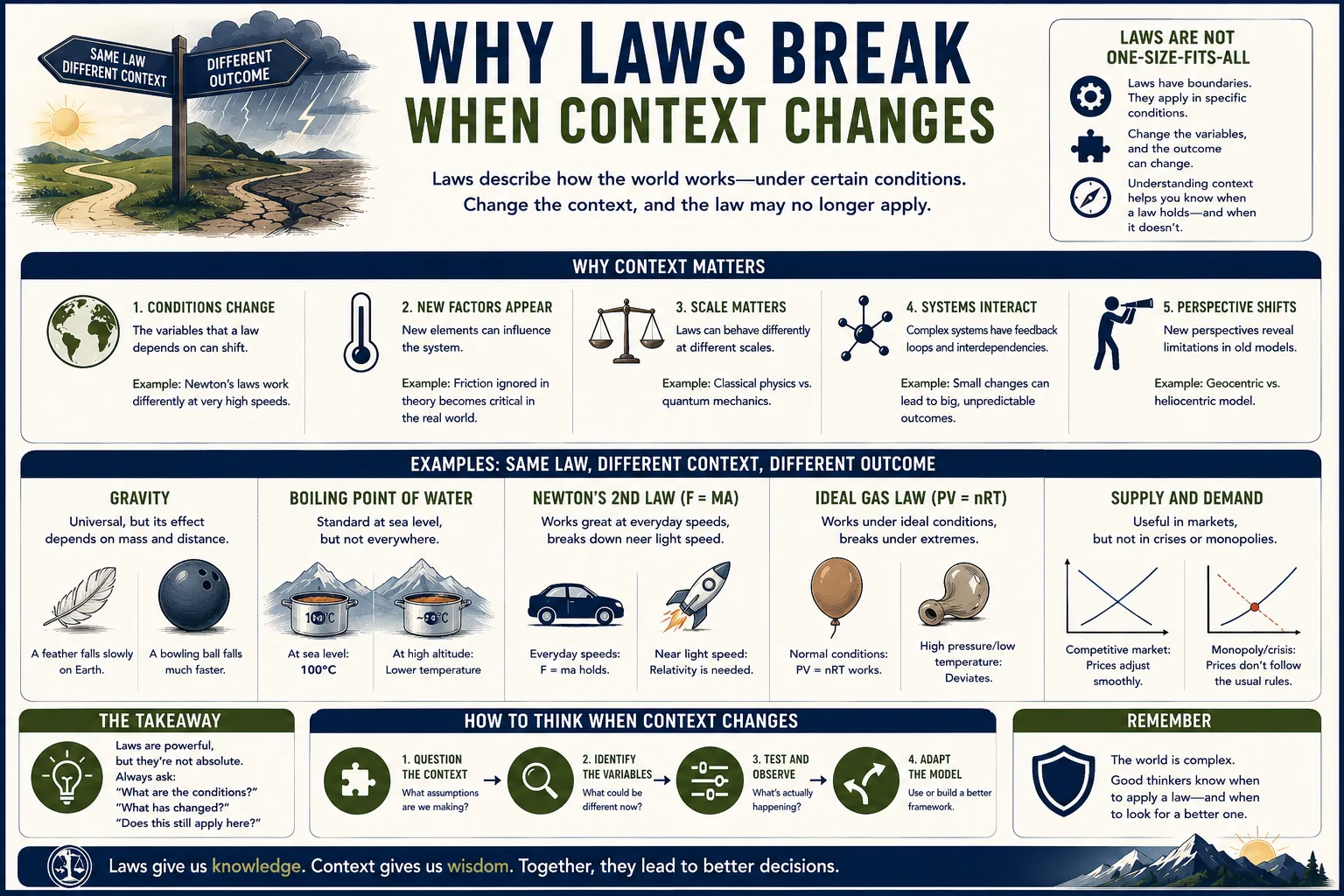
Why Laws Break When Context Changes
This is the CitePep accuracy record for “Why Laws Break When Context Changes”, published by When Notes Fly. It lists every change experts checked and accepted on that page.
Laws break when context changes because they're context-dependent. Diversification reduces risk in stable markets but fails in correlated crises.
What has been corrected on this page?
Every accepted correction to this page is recorded with the exact change, so readers can see how the page improved over time.
-
Corrected John Ioannidis's institutional affiliation in his real 2005 JAMA study: the article claimed Stanford University, but Ioannidis was at the University of Ioannina and Tufts-New England Medical Center at the time (his Stanford appointment came in 2010).
Also corrected the article's unsupported causal explanation for why highly cited findings were later contradicted or weakened - the article attributed it to patient-population selectivity, but the paper's own stated explanation is smaller sample sizes and nonrandomized study designs.
What the page claimedArticle cited the wrong institutional affiliation for a real researcher at the time of a specific publication, and added a causal explanation not confirmed by the paper itself.
What was correctedCorrected the affiliation to Ioannidis's real 2005-era institutions and replaced the unsupported causal explanation with the paper's actual stated reasoning.
Why: The James March 1991 Organization Science citation and the Gordon Guyatt/McMaster evidence-based-medicine citation in the same article both verified as fully accurate; the combined 32 percent figure is a correct (if unstated-as-such) sum of the paper's real 16 percent contradicted plus 16 percent weakened findings.
View the full record →
Who checked this page?
1 contributor has checked "Why Laws Break When Context Changes" on When Notes Fly. Each name below links to that person's public CitePep profile, where every contribution they have made is listed with the exact change they proposed.