
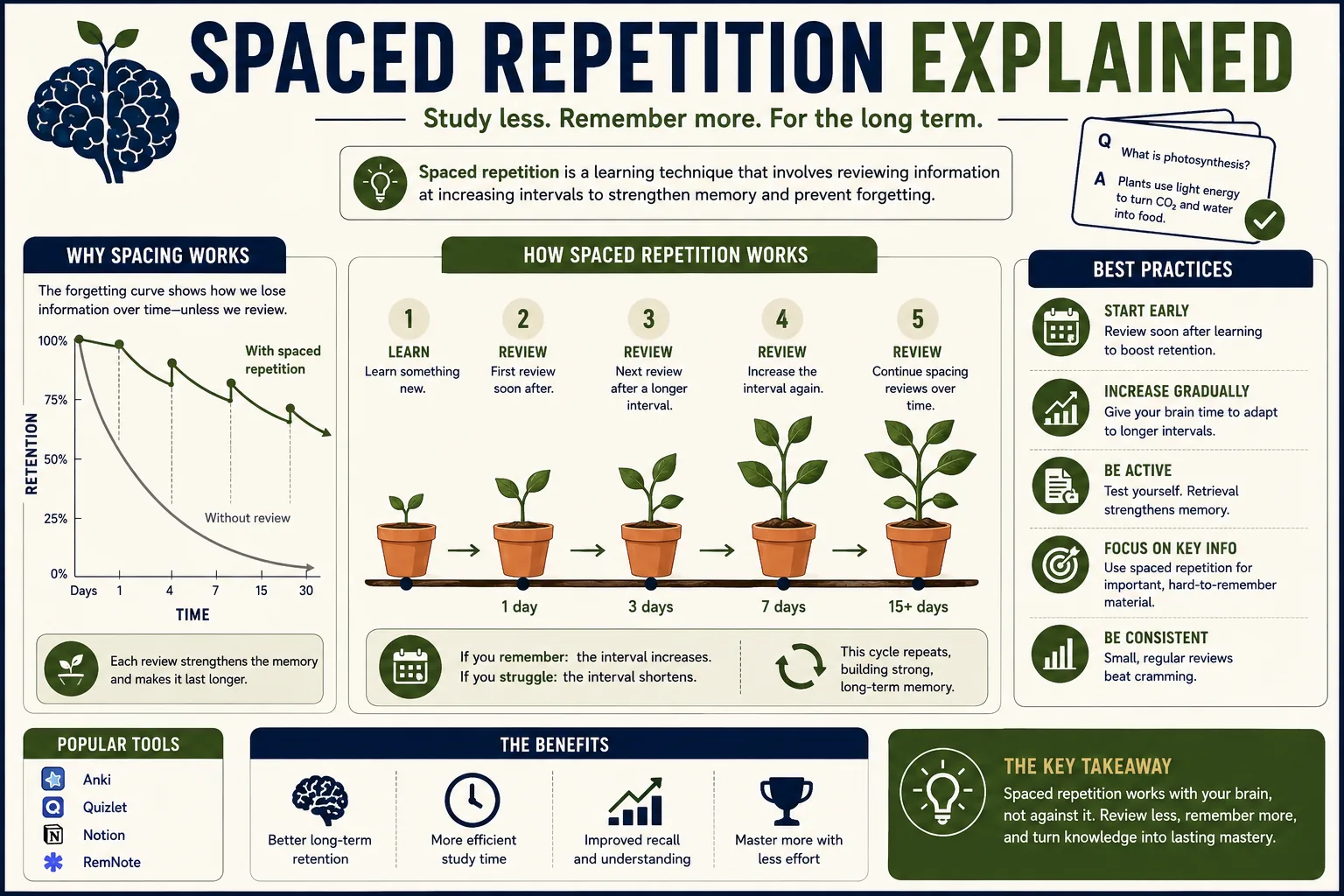
Spaced Repetition Explained
This is the CitePep accuracy record for “Spaced Repetition Explained”, published by When Notes Fly. It lists every change experts checked and accepted on that page.
Review information right before you forget it. Each successful retrieval strengthens memory more than re-reading does. Spacing beats cramming.
What has been corrected on this page?
Every accepted correction to this page is recorded with the exact change, so readers can see how the page improved over time.
-
Corrected 6 unverified or altered citations: an unverified Wisher/Sabol/Ellis 2002 Military Psychology paper with unverified statistics (the real 1999 study is a US Army Research Institute report, not a journal article);
an unverified 2019 University of Michigan Anki/USMLE study (the real 2015 study is by Deng and colleagues at Washington University in St. Louis, correlational rather than a controlled comparison, with a different statistic); an entirely unverified 'Sense Education' spaced-repetition study (replaced with Duolingo's real published large-scale research);
an Axonify/Walmart statistic that used the wrong metric (real figure is a 54 percent reduction in safety incidents, not knowledge retention) plus an unverified, unverifiable TD Bank statistic; an entirely unverified NASA Johnson Space Center astronaut training program and statistics;
and Paul Nation's real vocabulary-threshold research altered (his real newspaper-reading threshold is 8,000-9,000 word families, not 5,000) with an unverified pacing recommendation and acquisition-timeline comparison.
What the page claimedArticle attached unverified studies, wrong journals/years/institutions, and unverified statistics to real researchers, companies, and government agencies across nearly every case study.
What was correctedCorrected each citation to its real, verifiable source and findings where one exists, replaced the entirely unverified Sense Education and NASA claims with accurate real-world analogs, and corrected Nation's vocabulary thresholds to his real published figures.
Why: This was one of the most fabrication-dense articles in the batch - nearly every specific case study needed correction, following the consistent pattern across this legacy content of real entities used as credibility scaffolding for unverified precision.
View the full record →
Who checked this page?
1 contributor has checked "Spaced Repetition Explained" on When Notes Fly. Each name below links to that person's public CitePep profile, where every contribution they have made is listed with the exact change they proposed.