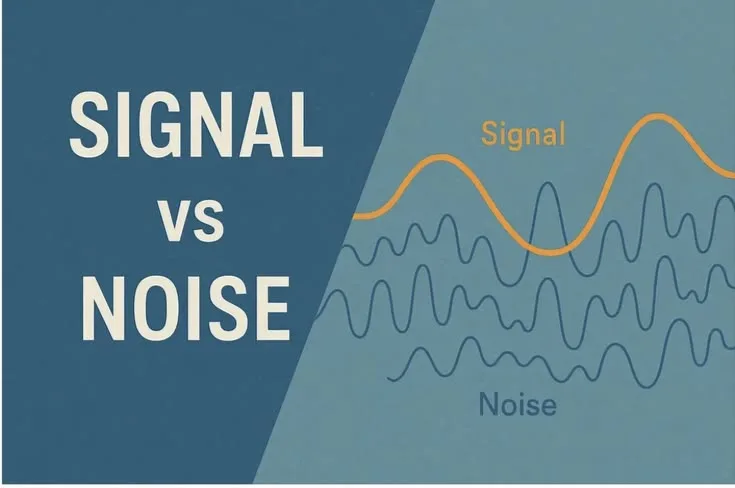
Signal vs. Noise in Communication: How to Prioritize What Your Audience Needs
This is the CitePep accuracy record for “Signal vs. Noise in Communication: How to Prioritize What Your Audience Needs”, published by When Notes Fly. It lists every change experts checked and accepted on that page.
How to prioritize what your audience needs: six types of communication noise, when redundancy is purposeful, and a practical test for what to cut.
What has been corrected on this page?
Every accepted correction to this page is recorded with the exact change, so readers can see how the page improved over time.
-
A claim-level review of this article on signal and noise found a fabricated experiment, several misrepresented studies, and invented numeric thresholds.
The page described a 'landmark 2000 study' in which David Kirsh had participants sort objects from cluttered versus uncluttered workspaces; the cited Kirsh paper is a conceptual article on workplace cognitive overload and contains no such two-condition experiment, and the DOI given for it did not resolve.
It attributed to Helmreich, Merritt and Wilhelm a five-year study finding substantially lower accident rates at airlines with stronger Crew Resource Management, a result that paper does not report and which was absent from the bibliography. It stated a 15-20 percent threshold of processing effort above which structure 'has become noise', with no measurement method or source.
It presented Miller's 1956 paper as establishing a universal seven-item working-memory limit, conflated Mayer's coherence and redundancy principles, attributed an unsourced package of language-complexity findings to Sian Beilock including the claim that expertise 'rewires the brain', and asserted that Amazon Prime, AWS and Echo would not have survived a slide-based process.
The Columbia opening also overstated what a Boeing presentation had concluded and blurred what investigators later determined against what was known during the mission.
What the page claimedThe article stated: 'In a landmark 2000 study, psychologist David Kirsh asked participants to sort objects into categories after viewing a workspace', reporting that those shown only relevant objects sorted faster and more accurately. It stated that 'A five-year study by Helmreich, Merritt, and Wilhelm (1999) found that airlines with stronger CRM implementation showed substantially lower accident rates - a direct measure of the value of signal quality improvements.' It instructed readers that 'If structure is consuming more than about 15-20% of processing effort, it has become noise', and that a section which could be removed without the receiver noticing 'is noise by definition'. It described Miller's 1956 paper as having 'quantified the central bottleneck: human working memory can hold only about seven items at once' and claimed that once saturated, 'signal reception degrades sharply - not gradually'. It presented Mayer's redundancy findings and then labeled the principle 'coherence', calling it 'one of the most replicated findings in educational psychology'. It attributed to Sian Beilock findings that experts use more technical vocabulary, more complex sentences and more implicit references 'precisely because expertise rewires the brain'. It claimed Amazon Prime, AWS and Echo were 'none of which were conventional ideas that would have survived a slide-based presentation process'. The opening said an engineer at Boeing 'had produced a detailed technical presentation showing that the damage posed a potentially catastrophic risk' and that 'The cause of the physical failure was already known'. It also asserted that information theory 'applies directly to human communication' and that unedited drafts are 'typically twice as long as the final version should be'.
What was correctedThe Kirsh paragraph was deleted; the cited paper is a conceptual article on workplace cognitive overload containing no such experiment, and its DOI was corrected from a non-resolving identifier to 10.3406/intel.2000.1592. The Helmreich accident-rate claim was deleted, and the CRM account was corrected to note that Crew Resource Management emerged in commercial aviation around the late 1970s, evolved over subsequent generations, and covers teamwork, leadership, decision-making, workload management, situational awareness and threat and error management, with a note that accident-level evaluation is methodologically difficult. The 15-20 percent threshold, the 'noise by definition' circularity, the 'twice as long' ratio, the 'degrades sharply' contrast and the Amazon counterfactual were all removed. Miller's account now notes that later work often estimates roughly three to four meaningful chunks depending on task and grouping. Mayer's coherence and redundancy principles are now described separately, with the redundancy effect bounded to the conditions under which it holds and an explicit note that concise labels and accessibility captions can be essential. The Beilock section was replaced with Nickerson's curse-of-knowledge research and the 'rewires the brain' phrasing deleted. The Columbia opening now separates what investigators later determined from what was known during the mission, describes the Boeing slides as the investigation characterised them, attributes the hierarchy-filtering observation to Tufte's analysis, and states that presentation format was one manifestation of a broader organizational failure. Shannon's noise is now presented as an analogy rather than a direct theory. New material adds a six-type noise taxonomy, a section on purposeful redundancy covering read-backs and SBAR, and the audience-dependence of relevance. The five-question framework is labeled a WhenNotesFly editorial framework and restructured to sort content into main message, supporting evidence, appendix, or removable. Claim-level sources were added and decorative ones removed. Length was reduced from about 3,780 to about 2,820 words.
Why: A claim-level review found one fabricated experiment attributed to a real paper, one research finding attributed to a paper that does not report it, several invented numeric thresholds, two conflated multimedia-learning principles, an unsourced attribution of language findings to a named researcher, and a case-study opening that compressed hindsight and contemporaneous knowledge into a single misleading narrative.
The underlying pattern was a useful editorial metaphor being supported with borrowed scientific authority it did not have. Corrections remove the unsupported claims, bound each retained claim to what its source actually establishes, label editorial synthesis as such, and add the audience-dependence and purposeful-redundancy qualifications the original framing omitted.
View the full record →
Who checked this page?
1 contributor has checked "Signal vs. Noise in Communication: How to Prioritize What Your Audience Needs" on When Notes Fly. Each name below links to that person's public CitePep profile, where every contribution they have made is listed with the exact change they proposed.