
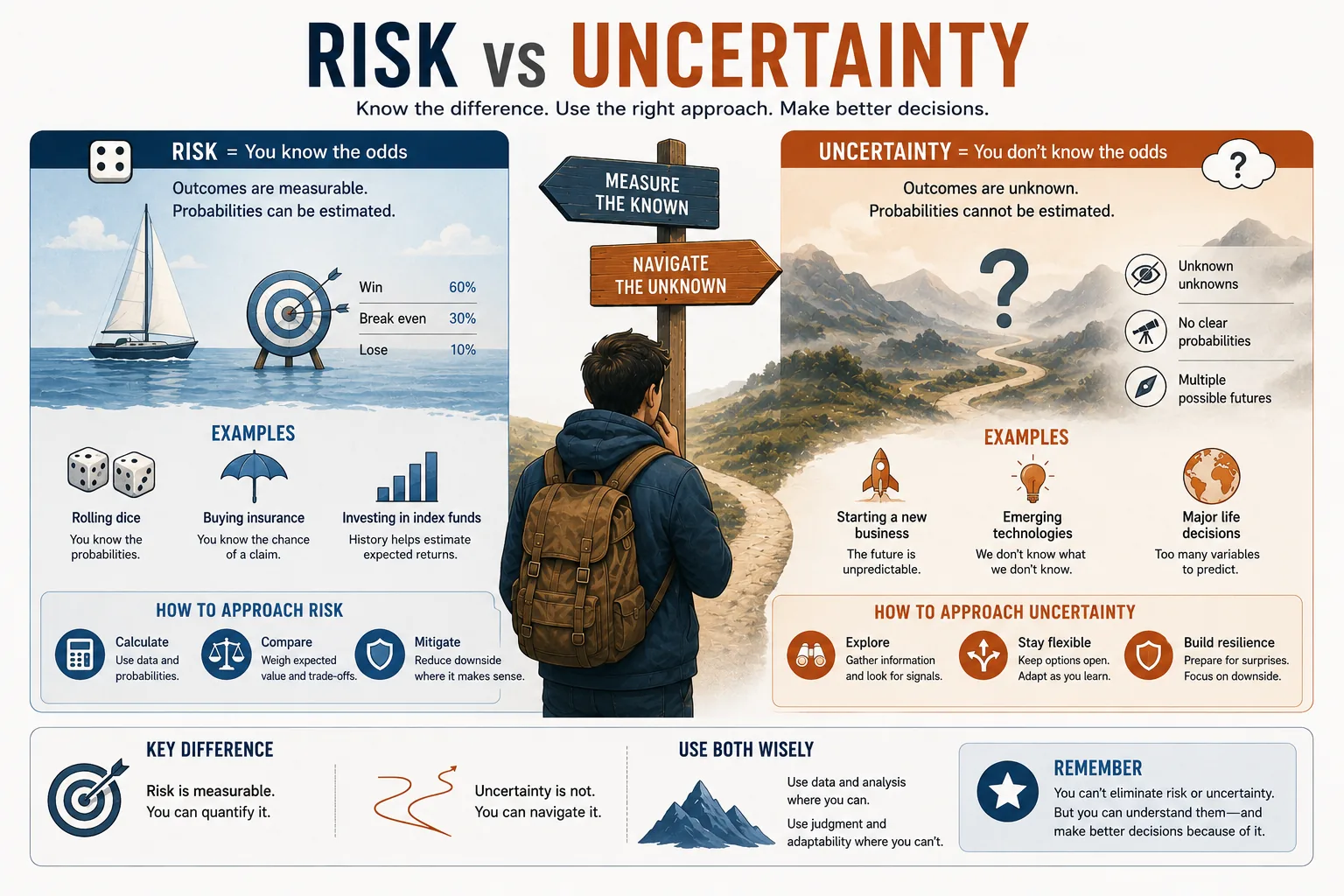
Risk vs Uncertainty: What People Confuse
This is the CitePep accuracy record for “Risk vs Uncertainty: What People Confuse”, published by When Notes Fly. It lists every change experts checked and accepted on that page.
Risk has known probabilities; uncertainty doesn't. With risk you can calculate odds, with uncertainty you can't even assign probabilities to outcomes.
What has been corrected on this page?
Every accepted correction to this page is recorded with the exact change, so readers can see how the page improved over time.
-
Flagged one quotation's uncertain provenance: 'Uncertainty is not the absence of knowledge. It is the presence of unknowns.' is a widely circulated paraphrase of themes from Frank Knight's 1921 Risk, Uncertainty and Profit, but this exact wording could not be verified to be a direct quotation from the text.
Verified accurate and left in place: Frank Knight's risk/uncertainty distinction (1921), Keynes's A Treatise on Probability (1921) and its parallel distinction, and the Good Judgment Project's documented superforecaster practices (explicit uncertainty acknowledgment, Bayesian updating, question decomposition).
What the page claimedThe article presented a specific quotation as a direct Frank Knight quote without noting its uncertain provenance.
What was correctedAdded a note that the quotation is a widely circulated paraphrase rather than a verified direct quotation from Knight's original text.
Why: The quotation is commonly attributed to Knight online but its exact wording could not be verified traceable to his 1921 book. Correction adds the appropriate caveat rather than removing the (broadly accurate) idea it conveys.
View the full record →
Who checked this page?
1 contributor has checked "Risk vs Uncertainty: What People Confuse" on When Notes Fly. Each name below links to that person's public CitePep profile, where every contribution they have made is listed with the exact change they proposed.