
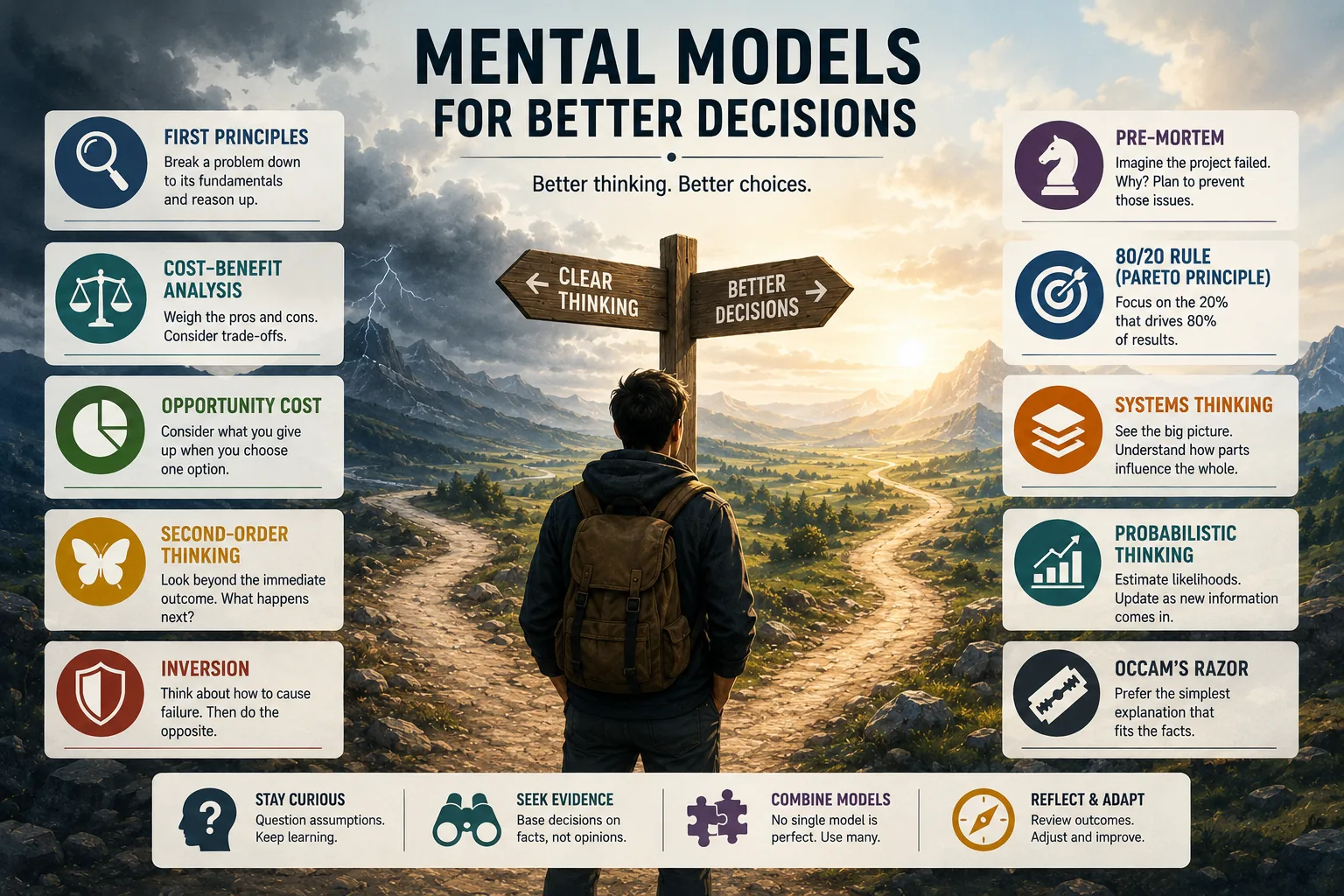
Mental Models That Make Every Decision Sharper
This is the CitePep accuracy record for “Mental Models That Make Every Decision Sharper”, published by When Notes Fly. It lists every change experts checked and accepted on that page.
Second-order thinking, inversion, and first principles expose what you're missing. The right mental model turns a hard decision into an obvious one.
What has been corrected on this page?
Every accepted correction to this page is recorded with the exact change, so readers can see how the page improved over time.
-
Corrected mis-cited or unverifiable studies and an engineering figure: re-cited Berk and van Binsbergen to their 2015 Journal of Financial Economics paper and its actual finding (managers show measurable skill that is largely captured by fees and fund size, with only a modest fraction beating benchmarks after fees) rather than a 2016 '10-15% skill' claim;
generalized an unverifiable 2019 Laurent Fresard finding about consistent-framework managers to what fund-style research supports, noting a consistent style does not guarantee outperformance; generalized an unverifiable Ericsson, Whyte, and Ward (2007) Academic Medicine diagnostic-accuracy result to the established expertise finding about illness scripts and pattern recognition;
and corrected engineering safety factors from a fixed 5-10x to field-dependent values (often roughly 1.5-3x for many structures, higher where failure is catastrophic). Practitioner cases such as the SpaceX first-principles example were kept as illustrations rather than proof that a specific mental model caused performance.
What the page claimedThe article cited a Berk-van Binsbergen 2016 JFE 10-15% skill finding, a Fresard 2019 consistent-framework result, an Ericsson-Whyte-Ward 2007 diagnostic-accuracy study, a fixed 5-10x engineering safety factor, and practitioner cases proving mental models caused performance.
What was correctedFixed the Berk-van Binsbergen citation and finding, generalized the unverifiable Fresard and Ericsson results, corrected the safety-factor figure, and framed practitioner cases as illustrations.
Why: Several citations named the wrong year/journal or a study that could not be verified, and the safety-factor figure was wrong. Corrections fix the citations and figures and scope the claims rather than adding new sources.
View the full record →
Who checked this page?
1 contributor has checked "Mental Models That Make Every Decision Sharper" on When Notes Fly. Each name below links to that person's public CitePep profile, where every contribution they have made is listed with the exact change they proposed.