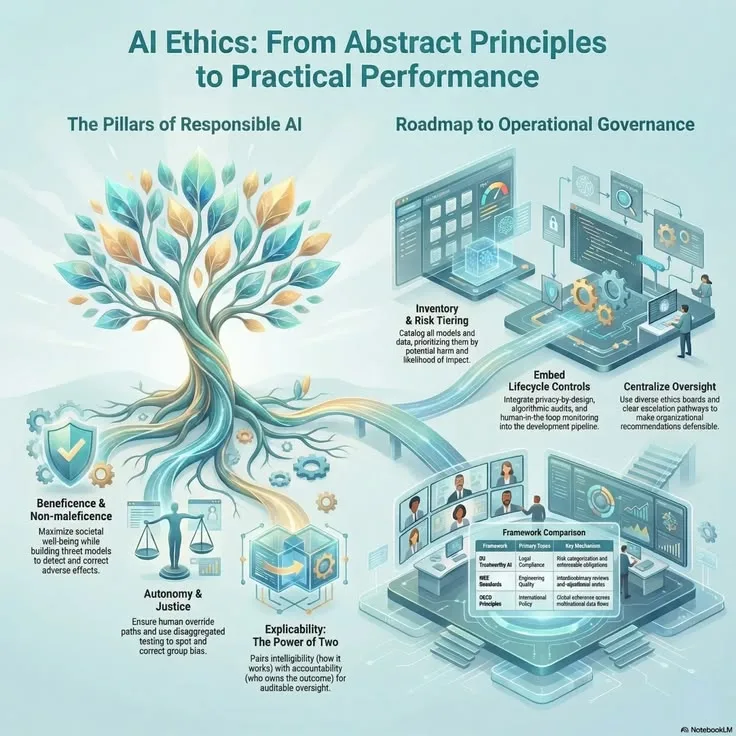
Key Concerns in AI Ethics and Societal Impact
Explore crucial AI ethical issues such as bias, privacy, transparency, job displacement, and their societal implications.
What has been corrected on this page?
Every accepted correction to this page is recorded with the exact change, so readers can see how the page improved over time.
-
Corrected inflated and misattributed statistics in the article's automation-and-employment section: Acemoglu and Restrepo's real 2020 robots-and-jobs study found a 0.2 percentage point employment decline and 0.42 percent wage decline per robot per thousand workers, not the '0.4 percent' and '0.8 percent' figures cited (roughly double the real numbers);
and the article's claimed 2024 Acemoglu/Restrepo AI-specific follow-up study with '2.1 to 3.3 percent' lower employment growth does not exist. The real 2024/2025 AI-and-commuting-zones study is by Bonfiglioli, Crino, Gancia, and Papadakis, with an actual headline effect of 0.6 percentage points.
What the page claimedArticle cited specific employment and wage statistics for real, well-known economists' research that were roughly double the actual published figures, and attributed a nonexistent 2024 study to the wrong research team.
What was correctedCorrected the 2020 Acemoglu/Restrepo statistics to match their real published figures; replaced the unverified 2024 Acemoglu/Restrepo AI study with the real Bonfiglioli/Crino/Gancia/Papadakis study and its actual finding.
Why: Real economists' well-known research was cited with statistics inflated roughly twofold, plus an unverified follow-up study attributed to the wrong authors - the Mayson/Chouldechova and Frey/Osborne/Arntz-Gregory-Zierahn citations in the same article verified as accurate.
View the full record →
Who checked this page?
1 contributor has checked "Key Concerns in AI Ethics and Societal Impact" on When Notes Fly. Each name below links to that person's public CitePep profile, where every contribution they have made is listed with the exact change they proposed.