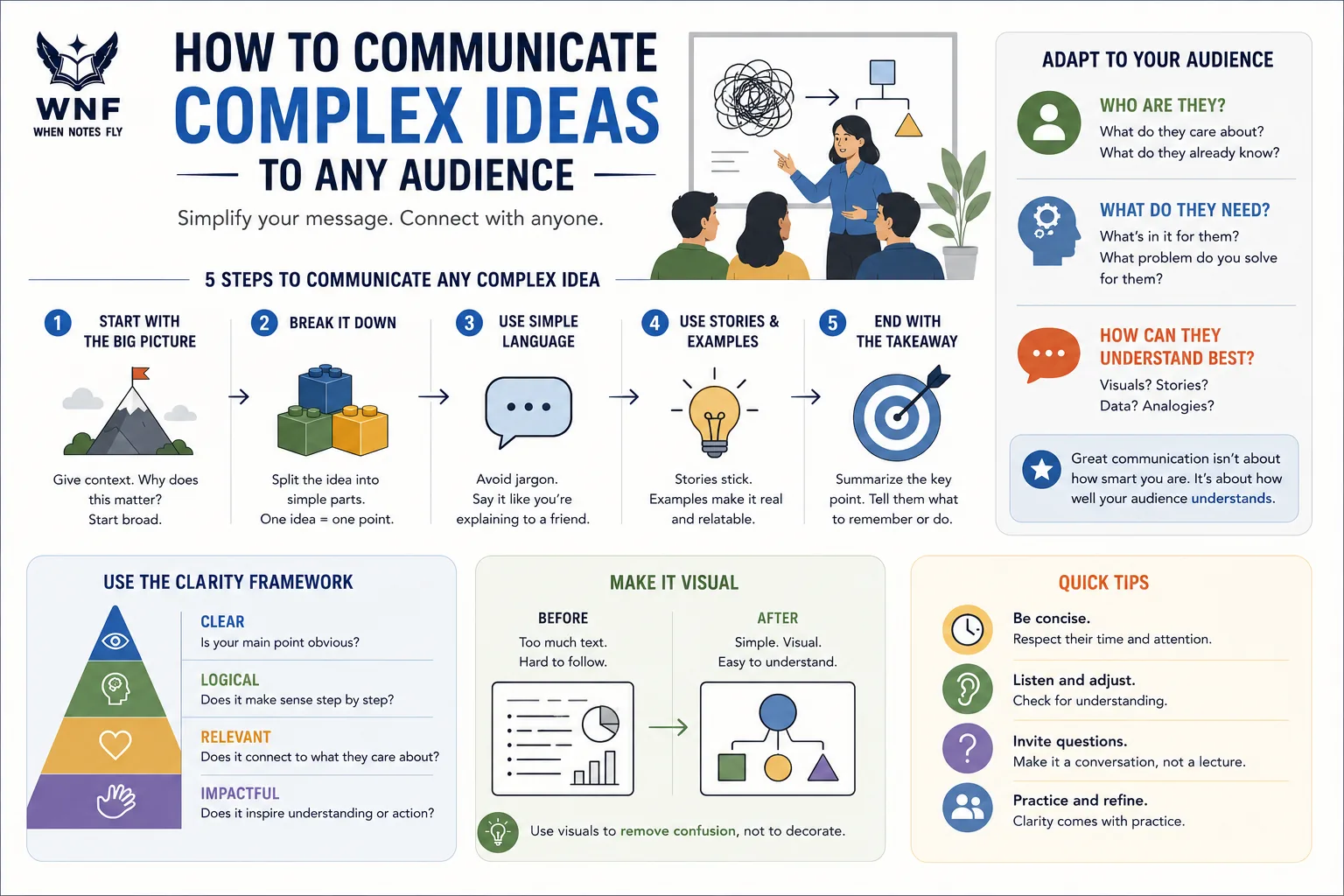
How to Explain Complex Ideas Clearly to Different Audiences
This is the CitePep accuracy record for “How to Explain Complex Ideas Clearly to Different Audiences”, published by When Notes Fly. It lists every change experts checked and accepted on that page.
A practical method for explaining complex ideas: define the intended action, build the minimum accurate model, sequence dependencies, and verify understanding.
What has been corrected on this page?
Every accepted correction to this page is recorded with the exact change, so readers can see how the page improved over time.
-
A review of this article on explaining complex ideas found two near-identical versions of the same quotation about the illusion of communication, both attributed to George Bernard Shaw, an attribution that quote-history research does not support. It also found an Einstein quotation with no reliable primary source, which additionally contradicted the surrounding argument.
A ten-source bibliography was attached to roughly 700 words of body text without any claim-level citations, including a PNAS commentary on science teaching methods that the article never discussed and two entries linked to Wikipedia rather than to the cited works.
A four-part explanatory framework was presented without attribution in a way that implied it came from the cited literature, the title promised a method that works for 'any audience', and the page provided no procedure, no worked example, and no treatment of analogy limits, uncertainty, audience goals, or accessibility despite a meta description promising practical guidance.
What the page claimedThe article carried two near-identical quotations about the illusion of communication ('The greatest enemy of communication is the illusion of it.' and 'The single biggest problem in communication is the illusion that it has taken place.'), both attributed to George Bernard Shaw and appearing within roughly 100 words of each other. It also quoted 'If you can't explain it simply, you don't understand it well enough' as often attributed to Albert Einstein, immediately alongside its own argument that explanation is not about making ideas simpler. The body ran to roughly 700 words while carrying ten academic references with no claim-level citations, including a PNAS commentary on science teaching methods that the article never discussed, and Bruner and Heath entries linked to Wikipedia rather than the cited works. A four-element framework of core structure, dependency order, representations, and cognitive load was presented without attribution. Cognitive load was defined only as 'the amount of information processed at one time', jargon was described purely as noise, and the page stated that 'the problem is not too much information', that explanation failures 'are structural, not personal', and that 'no explanation is complete on first delivery'. The title promised results for 'any audience', headings followed a template pattern such as 'Precise opening definition' and 'Concise synthesis', and the page contained no procedure, worked example, analogy limits, uncertainty guidance, or accessibility discussion.
What was correctedBoth Shaw quotations and the Einstein quotation were deleted, with the underlying point rewritten in the article's own words. The four-element model is now labeled the WNF structural-alignment framework and explicitly described as a WhenNotesFly synthesis drawing on cognitive-load theory, common-ground research, multimedia learning, and instructional scaffolding, with intended action added as a fifth element. The opening was rewritten in concrete language, and the simplification-versus-structure opposition was replaced with a distinction between useful simplification, which drops irrelevant detail, and false simplification, which drops constraints the conclusion depends on, illustrated with an antibiotics example. Categorical claims about information volume, structural causes, and first-delivery completeness were qualified. Each remaining source is now tied to a specific claim; the unused Wieman and Heath references were removed, both Wikipedia links were replaced with DOI and Harvard University Press records, and the Chi citation was corrected to Topics in Cognitive Science. New sections provide a step-by-step method, a worked public-key encryption example at child, general-adult, manager, and developer levels, a representation-selection table, three rules for analogy limits, Mayer-based guidance on words and visuals, Chi-based generative comprehension checks, a distinction between explanation and persuasion, uncertainty layering, accessibility considerations, and a pre-presentation checklist. The page was retitled 'How to Explain Complex Ideas Clearly to Different Audiences' and the template-style headings were replaced. Body length went from roughly 700 to roughly 1,900 words.
Why: A claim-level review found two misattributed quotations of the same aphorism, an unverified Einstein quotation that also contradicted the article's own argument,
and a bibliography that was largely decorative: ten sources attached to roughly 700 words with no claim-level citations, one reference on a subject the article never discussed, and two linked to Wikipedia rather than the works themselves. An original framework was presented in a way that implied it came from that literature.
Corrections remove the unsupported attributions, tie every remaining source to a specific claim, label the framework as editorial synthesis, and add the method, worked example, and practical detail the page's title and meta description already promised.
View the full record →
Who checked this page?
1 contributor has checked "How to Explain Complex Ideas Clearly to Different Audiences" on When Notes Fly. Each name below links to that person's public CitePep profile, where every contribution they have made is listed with the exact change they proposed.