
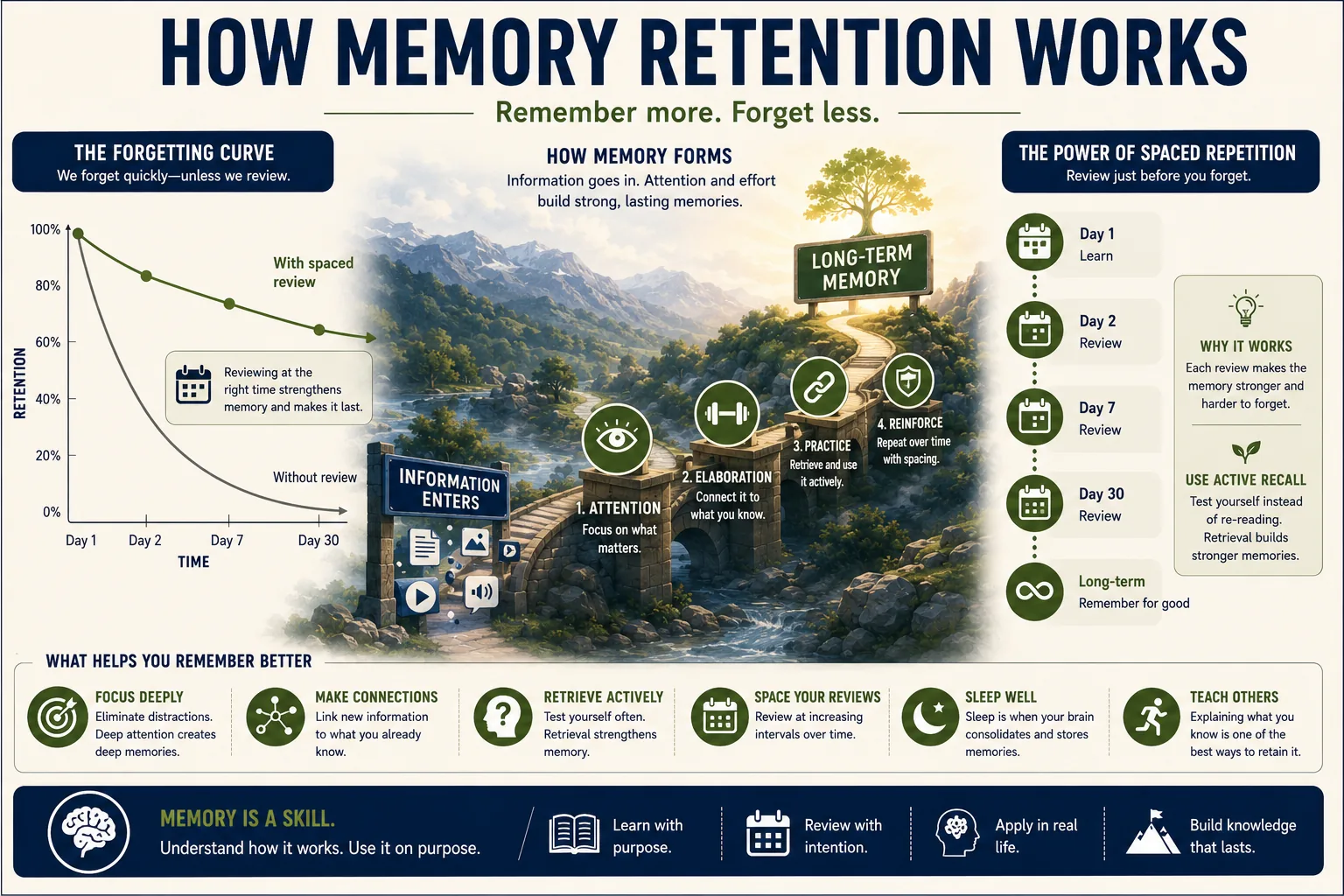
How Memory Retention Really Works
This is the CitePep accuracy record for “How Memory Retention Really Works”, published by When Notes Fly. It lists every change experts checked and accepted on that page.
Encoding creates memories; storage preserves them; retrieval strengthens them. Testing yourself embeds knowledge better than re-reading ever could.
What has been corrected on this page?
Every accepted correction to this page is recorded with the exact change, so readers can see how the page improved over time.
-
Corrected 4 citation errors: an unverified 'Wilfrid Laurier University medical school' spaced-repetition study with an unverified '36 percent' statistic (Wilfrid Laurier has no medical school at all); an overstated Born et al. 2004 Nature sleep-insight finding ('three times more likely' when the real study found roughly twice as many, about 60 percent vs 22 percent);
a misattributed nap-restoration finding credited to Stickgold, James and Hobson (2000) when it is actually Mednick, Nakayama and Stickgold's real 2003 study; and a sleep-deprivation/blood-alcohol equivalence statistic misattributed to David Dinges when it actually originates from Williamson and Feyer's 2000 study.
What the page claimedArticle cited specific researchers, institutions, and statistics for memory and sleep research that, on independent verification, were either impossible (a medical school that doesn't exist), overstated relative to the real published effect size, or correctly-stated findings credited to the wrong researcher.
What was correctedRemoved the unverified Wilfrid Laurier claim while preserving the real, general Ambrose spaced-repetition point; corrected the Born et al. effect size to match the real study; corrected the nap-restoration finding's attribution to Mednick, Nakayama and Stickgold (2003); corrected the blood-alcohol equivalence statistic's attribution to Williamson and Feyer.
Why: Real researchers and institutions were used as anchors for an impossible claim, an inflated statistic, and two citation swaps between real, closely-related studies - a more subtle variant of the fabrication pattern found across this batch of legacy articles.
View the full record →
Who checked this page?
1 contributor has checked "How Memory Retention Really Works" on When Notes Fly. Each name below links to that person's public CitePep profile, where every contribution they have made is listed with the exact change they proposed.