How Learning Actually Works According to Science
This is the CitePep accuracy record for “How Learning Actually Works According to Science”, published by When Notes Fly. It lists every change experts checked and accepted on that page.
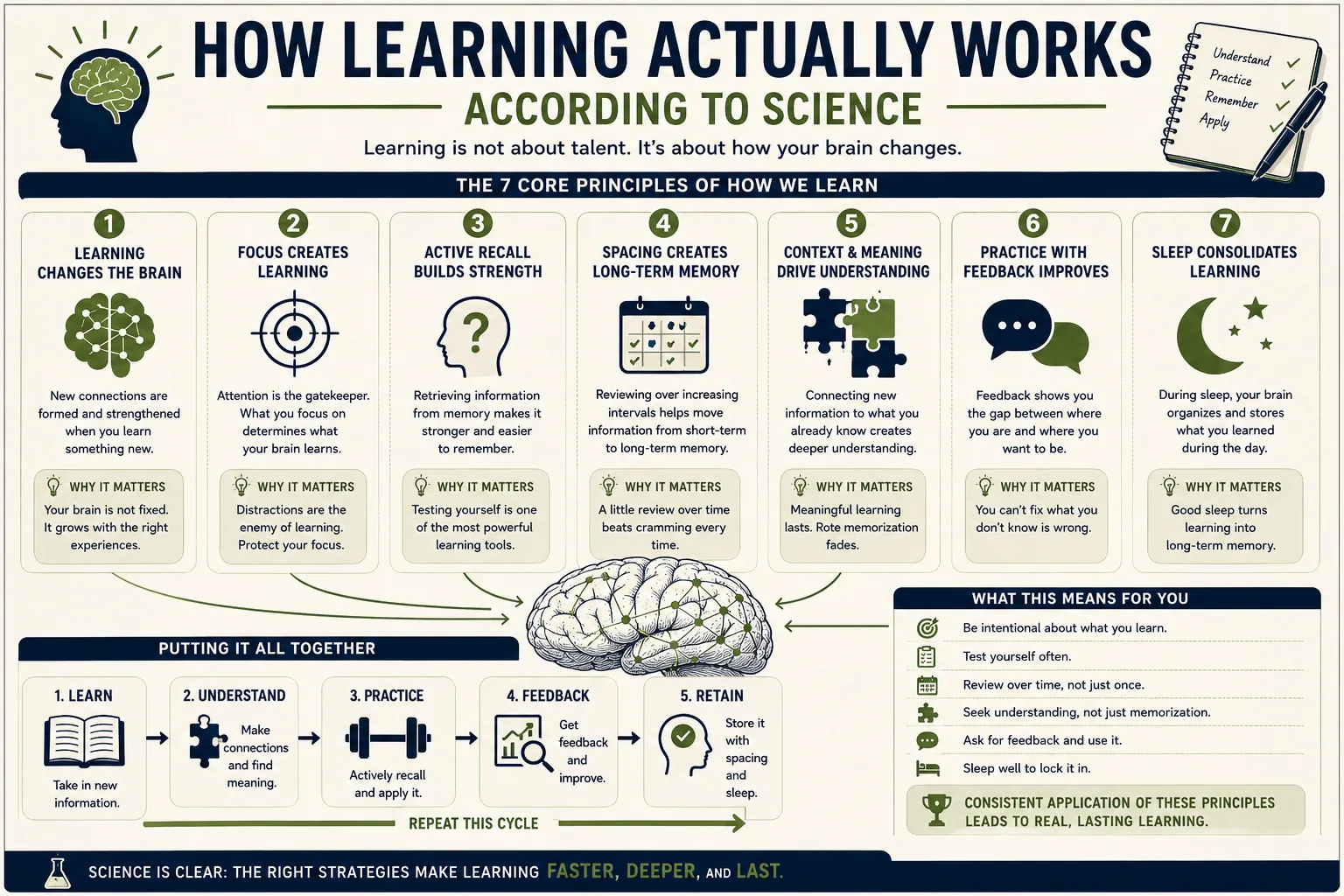
Re-reading and highlighting feel productive but are weak learning methods. Retrieval practice, spacing, and interleaving create durable understanding.
What has been corrected on this page?
Every accepted correction to this page is recorded with the exact change, so readers can see how the page improved over time.
-
Corrected two citations that misrepresented real research: a Doug Rohrer interleaving study was cited with the wrong journal and an unverified reversal narrative not found in his real published work, and a real Roschelle, Feng, Murphy, and Mason 2016 study was misdescribed as being about Khan Academy mastery-based learning when it actually studied a different platform, ASSISTments, with a much smaller and differently measured effect.
What the page claimedArticle attributed an unverified one-day-versus-one-month score reversal (89pct/72pct flipping to 38pct/61pct) to Rohrer in Psychological Science, and attributed an unverified 52 percent improvement figure and Khan Academy mastery-learning framing to the real Roschelle et al. 2016 study.
What was correctedRohrer's interleaving finding corrected to the real, replicated result (72 percent versus 38 percent on a two-week delayed test, published in Psychonomic Bulletin and Review and Journal of Educational Psychology); the Roschelle et al. citation corrected to accurately describe the real ASSISTments randomized trial and its real effect size of 0.18 standard deviations.
Why: Verified both named studies against their real published versions; found a real researcher's work altered with an unverified narrative in one case, and a real study's subject, platform, and effect size all misrepresented in the other.
View the full record →
Who checked this page?
1 contributor has checked "How Learning Actually Works According to Science" on When Notes Fly. Each name below links to that person's public CitePep profile, where every contribution they have made is listed with the exact change they proposed.