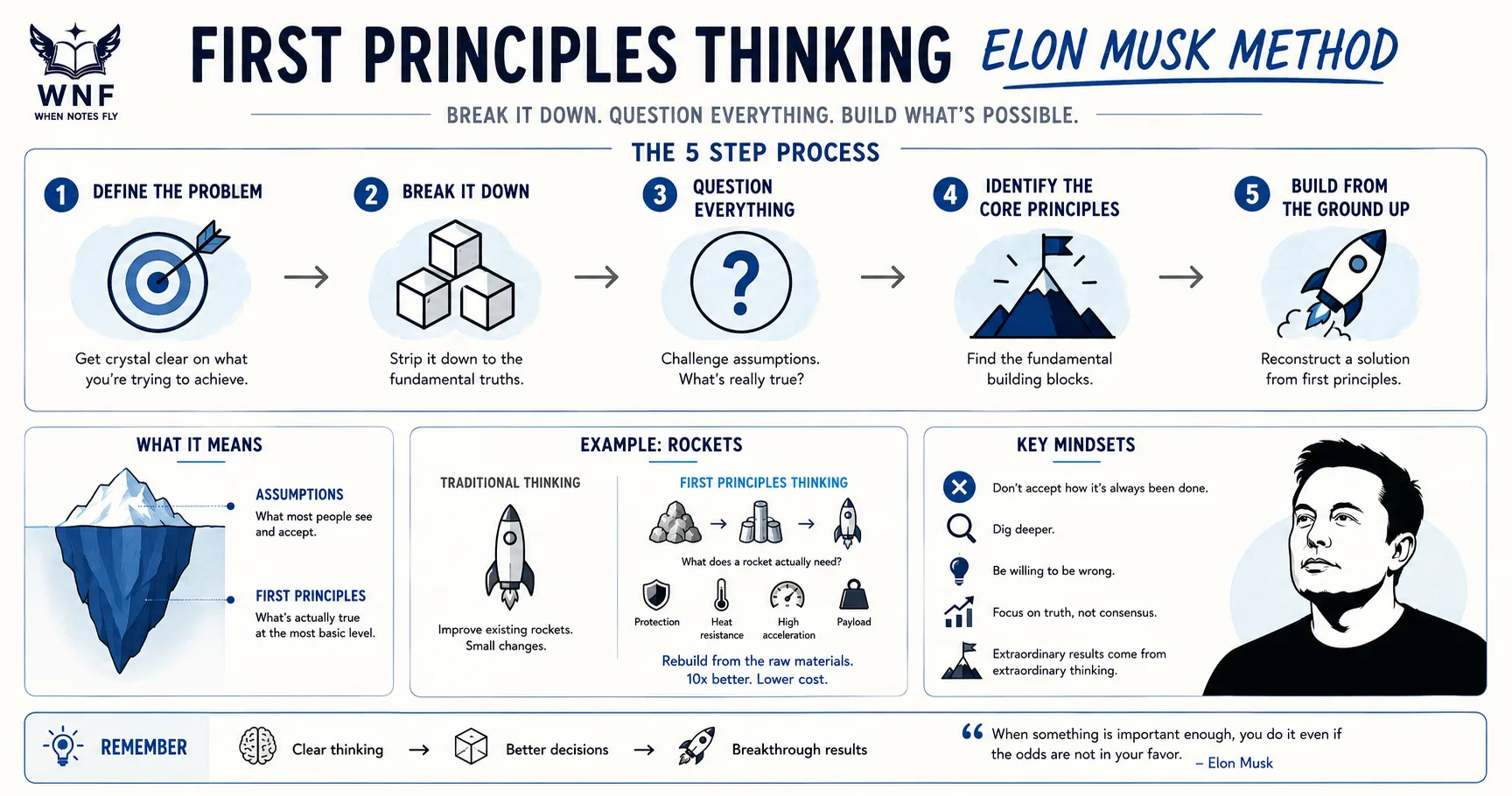
First Principles Thinking: Elon Musk's Approach Explained
This is the CitePep accuracy record for “First Principles Thinking: Elon Musk's Approach Explained”, published by When Notes Fly. It lists every change experts checked and accepted on that page.
Uncover the origins and applications of first principles thinking as used by Elon Musk to solve complex problems.
What has been corrected on this page?
Every accepted correction to this page is recorded with the exact change, so readers can see how the page improved over time.
-
This article on first principles thinking was largely well sourced and accurate, including its Tesla battery-cost example, its SpaceX example's underlying figures, and its accounts of Marshall and Warren's H. pylori discovery and Warren Buffett's investment philosophy.
Two issues were found: a direct quotation attributed to chip architect Jim Keller from a specific, real, checkable interview could not be verified anywhere in that interview's actual transcript, and a cost-reduction figure for SpaceX's reusable rockets overstated the reduction relative to the article's own cited baseline.
What the page claimedThe article quoted Jim Keller directly, attributing a specific multi-sentence statement to a named 2020 Lex Fridman podcast interview, when that exact quote could not be verified against the real, publicly available transcript of that interview. It also described Falcon 9 reusability as reducing launch costs by 'roughly an order of magnitude' when measured against the $10,000 per kilogram figure the article itself had just cited, a reduction that is closer to three to four times against that specific baseline.
What was correctedThe article now describes Jim Keller's real, general views on analogical versus first-principles reasoning without an unsourced direct quotation, and describes the SpaceX cost reduction more precisely as three to four times relative to the article's own cited baseline, noting that a full order-of-magnitude reduction holds only when compared against the highest historical launch costs, such as those of the Space Shuttle.
Why: A web search for the quoted passage attributed to Jim Keller, checked directly against the real interview's transcript, found no matching text, which is a more serious issue than an ordinary statistical error since it presents unverified wording as a verbatim, checkable statement from a real, named, living person.
The SpaceX figure was a defensible but generous rounding that did not match the article's own stated baseline. Both were corrected while preserving the article's otherwise accurate and well-documented examples.
View the full record →
Who checked this page?
1 contributor has checked "First Principles Thinking: Elon Musk's Approach Explained" on When Notes Fly. Each name below links to that person's public CitePep profile, where every contribution they have made is listed with the exact change they proposed.