Correction Concepts
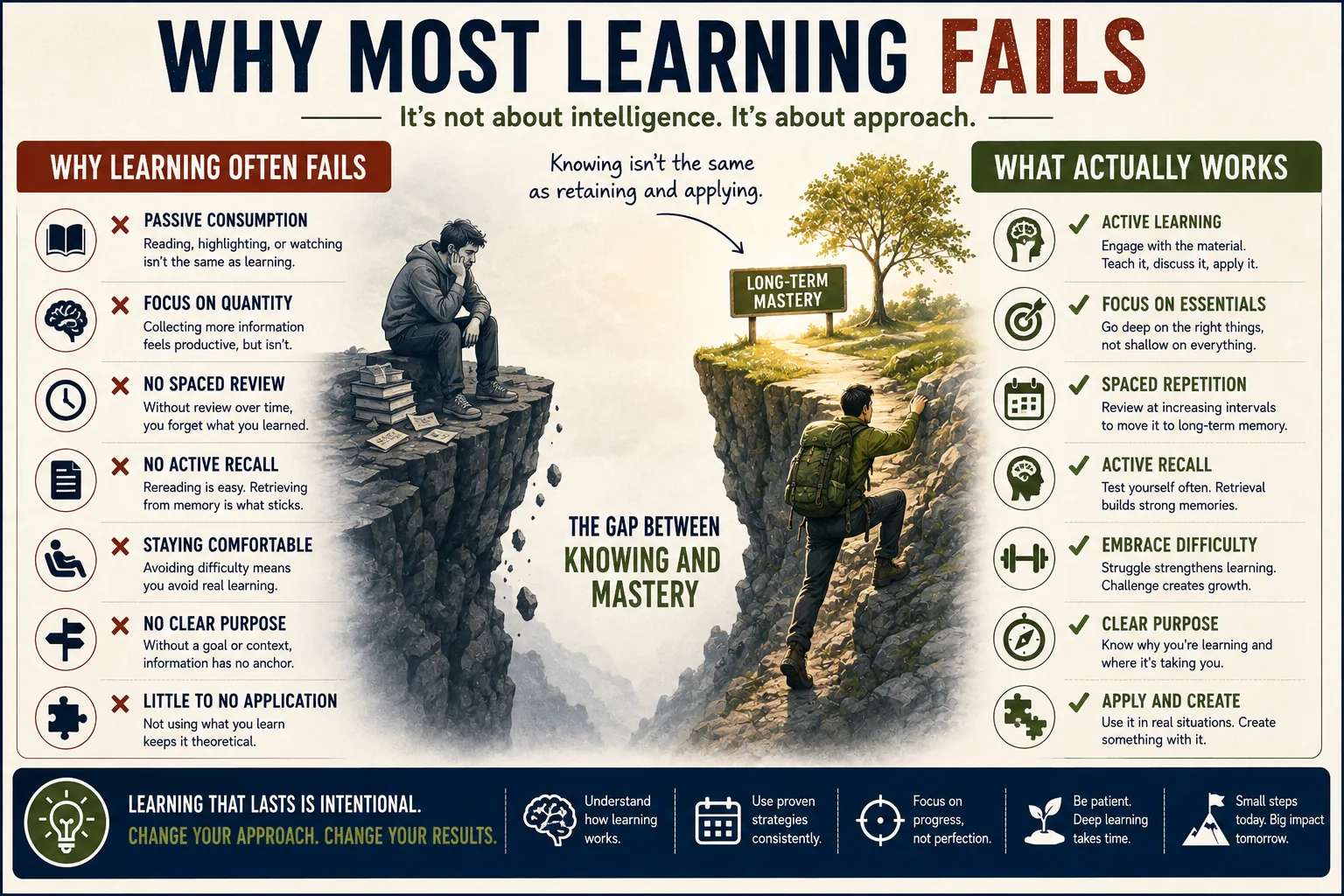
Why Most Learning Fails
Learning often fails due to misconceptions of mastery, lack of testing, and insufficient spacing in practice.
Factually incorrectNeeds stronger evidence
What was corrected
What the page claimed
The article attributed a specific PISA 2009 country-by-country pattern (Japan, Finland, and South Korea versus Greece and Italy) to unspecified sources when the real, documented research on this pattern uses 2006 PISA data and comes from economists Daniela Kuehn and Leire Landeras; attributed a re-reading versus concept-mapping versus retrieval-practice classroom study to Mark McDaniel at Washington University, when this is actually the well-known 2011 Science study by Jeffrey Karpicke and Janell Blunt at Purdue University, and gave an incorrect re-reading percentage; cited a 2015 study by 'Chetty and colleagues' at UCSF on pharmacist training retention that could not be verified anywhere; cited a 2016 Sitzmann and Weinhardt meta-analysis with a specific study count that could not be verified, when the real, closely matching correlation figures come from Alliger and colleagues' meta-analysis and related work by Sitzmann and colleagues; attributed a claim about standardized-assessment design specifically to psychometrics researcher Denny Borsboom, whose real published work does not include this claim; and attributed a 2018 corporate learning and development survey to the Kirwan Institute, a real research center that actually focuses on race and social justice research, not corporate training.
What was corrected
The section now correctly cites Kuehn and Landeras's real PISA research, correctly attributes the classroom study to Karpicke and Blunt at Purdue with their actual reported figures, removes the unverifiable pharmacist retention study in favor of an accurately hedged general statement about training-retention decay, replaces the unverifiable meta-analysis citation with the real Alliger et al. and Sitzmann et al. findings on the weak reaction-learning correlation, describes the assessment-design point in general terms without misattributing it to Borsboom, and describes the corporate lecture-reliance finding in general terms without the incorrect Kirwan Institute attribution.
Why this is better
Web searches for each citation found a mix of real studies misattributed to the wrong researcher or institution, a study that could not be verified under the cited authors and institution, and a well-known real study whose actual reported numbers differed from what was cited. Since the underlying research area and general findings are well established in the learning-science literature, the sections were rewritten to correct or remove the specific inaccuracies rather than deleting the material outright.
More by Emir Baycan in Concepts
- Correction Learning Myths That Refuse to Die
- Correction First Principles Thinking: Elon Musk's Approach Explained
- Correction Nine Methods to Learn Anything Faster and Effectively
- Correction The Limits of Rules