Correction Principles And Mental Models
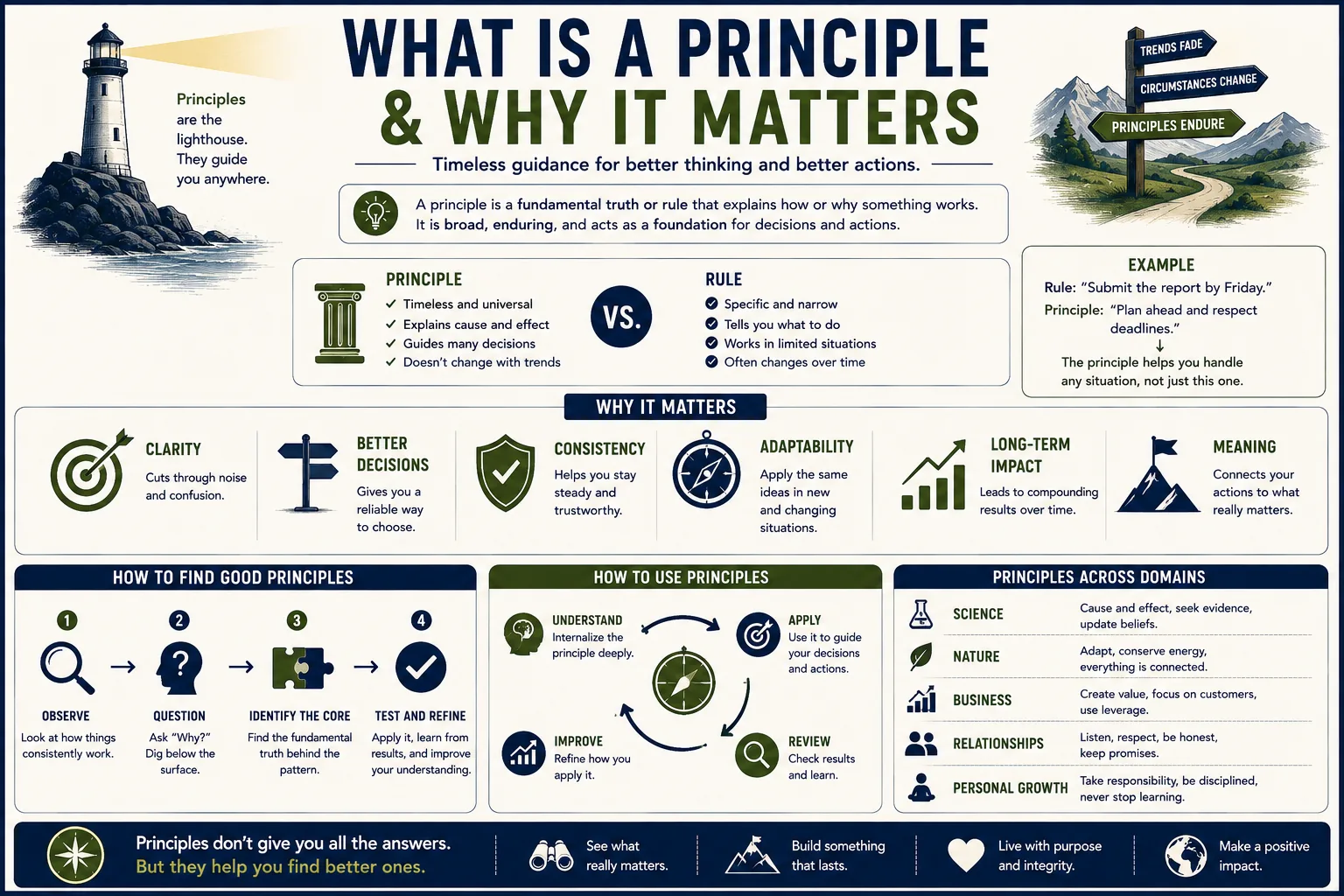
What Is a Principle and Why It Matters
Rules tell you what to do; principles tell you how to think. Principles transfer across contexts while rules remain situation-specific.
Needs stronger evidenceFactually incorrect
What was corrected
What the page claimed
Article included an unverified entire 2014 Psychological Science physics-instruction study and attributed it to Kathleen Vohs, a real University of Minnesota researcher whose actual work is on self-control and consumer psychology, not physics education - no such study exists in her real publication record. It misattributed Chi, Feltovich, and Glaser's real, famous 1981 expertise study to Carnegie Mellon University, when the real study was conducted at the University of Pittsburgh's Learning Research and Development Center. It included an unverified specific '60 countries' statistic for Jonathan Haidt's real Moral Foundations Theory research, when real cross-cultural studies cite varying country counts (25, 27, or 67 in different papers) and MFT's own stated position is that foundations are culturally widespread, not confirmed universal. It included an unverified academic attribution ('researchers from the University of Athens described it as market socialism') and a specific '50,000 revenue per employee' statistic for Valve Corporation that is off by roughly two orders of magnitude from real public estimates. And it included an unverified entire 2011 US Army War College study, including a co-author ('Douglas Naquin') who appears to be a real but unrelated intelligence-community figure with no connection to the real researcher Leonard Wong or to Mission Command research.
What was corrected
The Vohs passage was generalized to describe the real, well-supported finding about principle-based instruction without the included an unverified study. Chi, Feltovich, and Glaser's institution was corrected to the real University of Pittsburgh LRDC. Haidt's unverified country count was softened to an accurate general statement. The Valve passage was corrected to accurately describe Varoufakis's real role without the unverified academic framing and statistic. The unverified Mission Command study was removed and replaced with an accurate general statement about the real, well-documented advantages of principle-based command in high-uncertainty environments.
Why this is better
Independent verification found Anders Ericsson's Peak citation and Gary Hamel's W.L. Gore case study were both fully accurate as originally stated - continuing the pattern where some citations in an article hold up completely while others in the same article require correction or removal.