Correction Decision Making
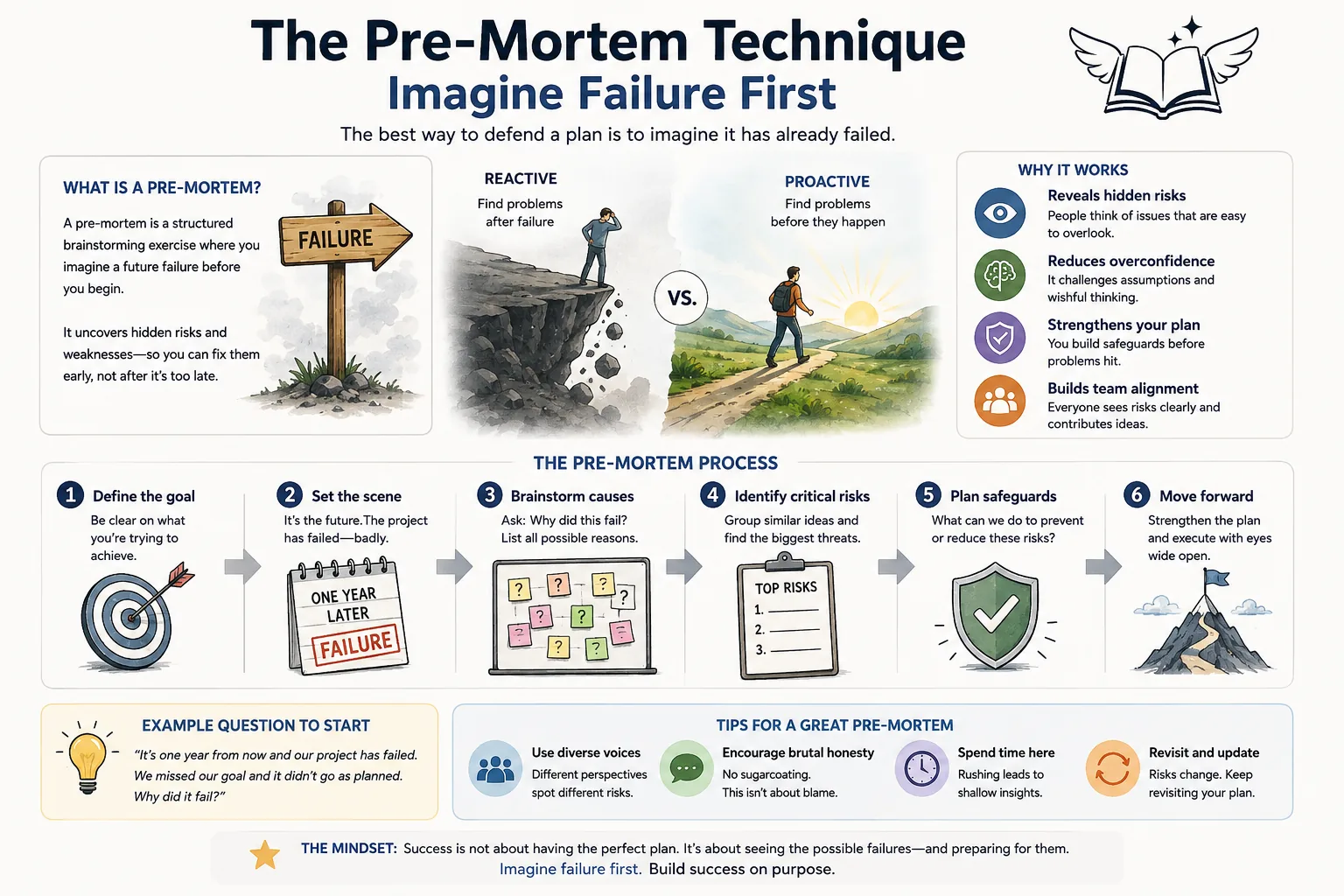
The Premortem: Imagining Failure Before It Happens
The premortem technique explained: how imagining a project has already failed, via prospective hindsight, surfaces risks that ordinary planning misses.
Factually incorrect
The exact change
Before
"Prospective hindsight - imagining that an event has already occurred - increases the ability to correctly identify reasons for future outcomes by 30%." - Deborah J. Mitchell, J. Edward Russo, and Nancy Pennington, Back to the future: Temporal perspective in the explanation of events (1989)
After
Participants asked to imagine a future outcome had already happened and to generate explanations for it produced significantly more reasons for that outcome than participants who were only asked to imagine the outcome might happen - the 1989 Mitchell, Russo, and Pennington study measured the number of reasons generated, not the accuracy of those reasons.
Why this is better
The blockquote misstated the actual Mitchell/Russo/Pennington (1989) finding: prospective hindsight was shown to increase the NUMBER of reasons people generated for a future outcome, not the ACCURACY of those reasons. Converted the blockquote to prose and corrected the claim in both the body and the FAQ.