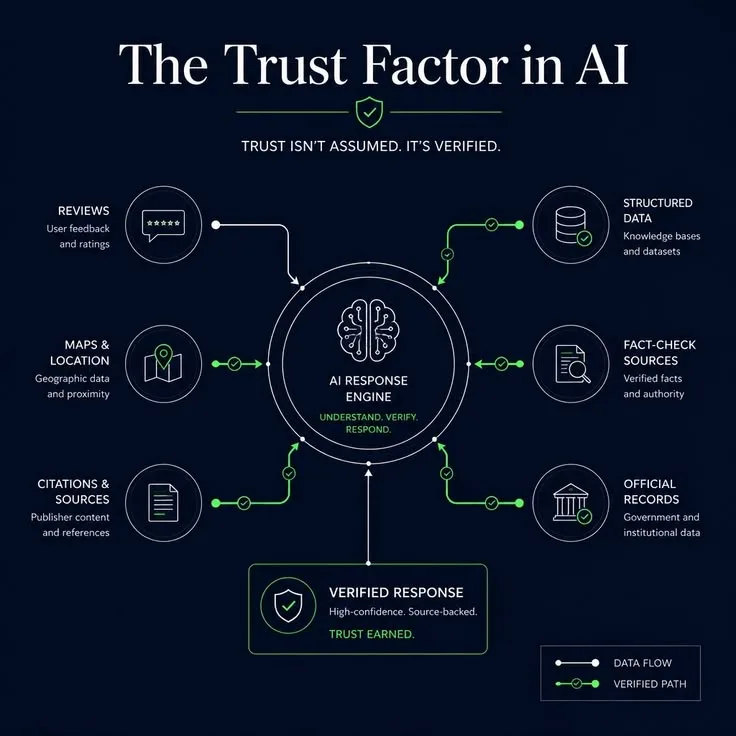
AI Source Trust Checklist: 10 Checks Before You Trust an AI Answer
AI source trust checklist: a free 10-check protocol for verifying AI answers, detecting fabrication, and calibrating scrutiny. For students and pros.
What was corrected
The bibliography included an unverified citation ('Wachsmuth, H., & Hou, Y. (2023). Towards a theory of the credibility of online sources. Computational Argumentation Research') - no such paper, authors-in-combination, or journal venue could be found; this appears to be an unverified reference. Separately, Dunlosky et al.'s real 2013 paper title was rendered as 'effective study techniques' instead of the correct 'effective learning techniques,' and Caulfield's real SIFT method work was dated 2019 instead of its original 2017 publication.
The unverified Wachsmuth & Hou entry was removed from the bibliography. The Dunlosky citation was corrected to the real paper title. The Caulfield citation was corrected to the real 2017 publication year.
Why this is better
This article is structurally distinct from the rest of this batch - a carefully-scoped, self-aware checklist about detecting AI hallucination, rather than a generated article with a bolt-on unverified research section. Independent verification found 5 of 6 bibliography entries fully real and accurately cited (Bender/Gebru/McMillan-Major/Shmitchell's Stochastic Parrots paper, Maynez et al.'s summarization faithfulness paper, and the Stanford History Education Group's Civic Online Reasoning curriculum, plus the two entries needing only minor corrections), with only one entry out of the full bibliography being outright unverified - a much lower fabrication rate than typical for this batch.